Sponsored
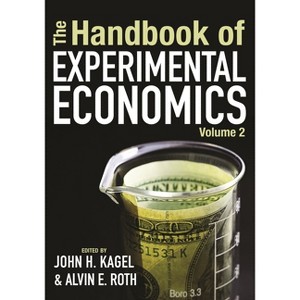
The Handbook of Experimental Economics, Volume 2 - by John H Kagel & Alvin E Roth
In Stock
Sponsored
About this item
Highlights
- An indispensable survey of new developments and results in experimental economics When The Handbook of Experimental Economics first came out in 1995, the notion of economists conducting lab experiments to generate data was relatively new.
- About the Author: John H. Kagel is University Chaired Professor of Applied Economics and director of the Economics Laboratory at Ohio State University.
- 776 Pages
- Social Science, Research
Description
Book Synopsis
An indispensable survey of new developments and results in experimental economics
When The Handbook of Experimental Economics first came out in 1995, the notion of economists conducting lab experiments to generate data was relatively new. Since then, the field has exploded. This second volume of the Handbook covers some of the most exciting new growth areas in experimental economics, presents the latest results and experimental methods, and identifies promising new directions for future research.
Featuring contributions by leading practitioners, the Handbook describes experiments in macroeconomics, charitable giving, neuroeconomics, other-regarding preferences, market design, political economy, subject population effects, gender effects, auctions, and learning and the economics of small decisions. Contributors focus on key developments and report on experiments, highlighting the dialogue between experimenters and theorists. While most of the experiments consist of laboratory studies, the book also includes several chapters that report extensively on field experiments related to the subject area studied.
- Covers exciting new growth areas in experimental economics
- Features contributions by leading experts
- Describes experiments in macroeconomics, charitable giving, neuroeconomics, market design, political economy, gender effects, auctions, and more
- Highlights the dialogue by experimenters with theorists and each other
- Includes several chapters covering field experiments related to the subject area studied
Review Quotes
"A critical review and analysis of the foundations of laboratory experiments in economics, and much more. . . . Indeed, this handbook serves as a thoughtful agenda for future researchers."-- "Choice"
"Several chapters, including those on neuroeconomics, political economy, and learning, have applications beyond economics to psychology and political science, a reminder of the growing role of interdisciplinarity in the social sciences. An excellent volume with extensive references."-- "Choice"
"The book provides not only a comprehensive and deep review of major areas of experimental research, but it is also exceptionally intellectually stimulating and insightful for theoretical economists as well as those who are interested in more immediate policy issues."---Katerina Sherstyuk, Economic Record
"This book is impressive for the clarity, depth, and informativeness of its surveys. The focus on series of experiments is very instructive. . . . One can learn a lot from the issues debated, the methodological digressions, and the many suggestions for further research. . . . This is a great book that is wholeheartedly recommended."---F. van Winden, Journal of Economics
"This is a book written principally to demonstrate the considerable scope and potential of economics experiments, and it achieves that objective very well."---Graham Loomes, Times Higher Education Supplement
About the Author
John H. Kagel is University Chaired Professor of Applied Economics and director of the Economics Laboratory at Ohio State University. Alvin E. Roth, co-winner of the 2012 Nobel Prize in economics, is the Craig and Susan McCaw Professor of Economics at Stanford University and the George Gund Professor of Economics and Business Administration Emeritus at Harvard University. They are the editors of The Handbook of Experimental Economics (Princeton).
Shipping details
Return details
Frequently bought together





Guests also viewed


Discover more options