Sponsored
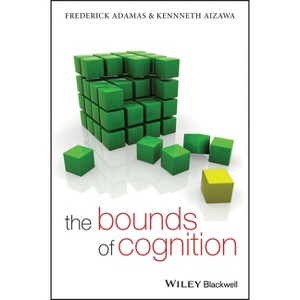
The Bounds of Cognition - by Frederick Adams & Kenneth Aizawa Paperback
In Stock
Sponsored
About this item
Highlights
- An alarming number of philosophers and cognitive scientists have argued that mind extends beyond the brain and body.
- About the Author: FREDERICK ADAMS is Professor of Cognitive Science & Philosophy and Chair of Linguistics and Cognitive Science at the University of Delaware.
- 224 Pages
- Philosophy, Mind & Body
Description
Book Synopsis
An alarming number of philosophers and cognitive scientists have argued that mind extends beyond the brain and body. This book evaluates these arguments and suggests that, typically, it does not.
- A timely and relevant study that exposes the need to develop a more sophisticated theory of cognition, while pointing to a bold new direction in exploring the nature of cognition
- Articulates and defends the "mark of the cognitive", a common sense theory used to distinguish between cognitive and non-cognitive processes
- Challenges the current popularity of extended cognition theory through critical analysis and by pointing out fallacies and shortcoming in the literature
- Stimulates discussions that will advance debate about the nature of cognition in the cognitive sciences
From the Back Cover
One is naturally inclined to say the tools that surround us--everything from paper and pencils to computers, clothing, and keys--complement our cognitive processing. That is common sense.
The Bounds of Cognition articulates and defends a theory of "the mark of the cognitive," a common sense approach to cognitive science that differentiates between cognitive and non-cognitive processes. Addressing the limits of the embodied mind, the mark of the cognitive is a refreshing alternative approach to "extended cognition" whose advocates--including a growing number of leading philosophers and psychologists--argue that cognitive processing is not "brain bound," and the mind extends beyond the boundary of the brain and body.
Putting their theory of the cognitive into practice, the authors analyze and expose some of the fallacies and shortcomings of extended cognition literature. The Bounds of Cognition is a timely and relevant text that exposes the need to develop a more sophisticated theory of cognition while allowing flexibility in exploring the nature of cognition.
Review Quotes
"Where is human cognition located? Is human cognitive processing literally constituted (at least partly) by non-neural portions of the environment? The contemporary debate about extended cognition and the extended mind focuses on these questions, among others. Frederick Adams and Kenneth Aizawa's new book, The Bounds of Cognition (BC), contributes wonderfully to this debate. The book is critical of the extended approach; but Adams and Aizawa (A&A) also work toward a positive view, one that allows, in principle, for extended cognition, while yielding very little of it when fed the empirical facts."(Philosophical Psychology, November 2010)
"The Bounds of Cognition is the most thorough-going, forceful, and compelling critique of EMH so far." ( Erkenntnis, September 2009)
"[This book] is without question a worthy and timely challenge to extended cognition, as well as to areas in related enterprises such as embodied cognition, situated cognition, dynamical systems theory and artificial life.... I recommend the book highly to anyone interested in these issues." (Phenomenology and the Cognitive Sciences, June 2009)
"This is a well written, well argued book. Written by philosophers mainly for philosophers.... It makes a serious contribution to the extended cognition debate that anyone with a serious interest in the issue needs to study." (Journal of Consciousness Studies, January 2009)
"Advocates of EMT must undoubtedly examine the arguments and criticisms that Adams and Aizawa offer in careful detail, because The Bounds of Cognition is the most forceful and most convincing criticism of their position so far." (Metapsychology, October 2008)
"The [authors] wrote this book as a reasoned challenge ... .[It] offers an excellent overview of the promise, limits, and problems of bounded cognition. Recommended." (Choice)
About the Author
FREDERICK ADAMS is Professor of Cognitive Science & Philosophy and Chair of Linguistics and Cognitive Science at the University of Delaware. He is also director of the Delaware Program in Cognitive Science. He publishes in epistemology, philosophy of language, philosophy of mind, and philosophy of science.
KENNETH AIZAWA is Charles T. Beaird Professor of Philosophy in the Department of Philosophy at Centenary College of Louisiana and is the author of The Systematicity Arguments (2003).
Shipping details
Return details



Discover more options