Sponsored
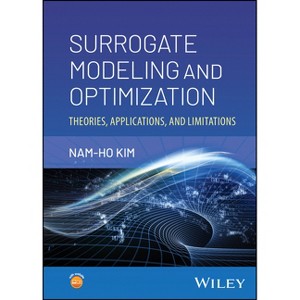
Surrogate Modeling and Optimization - by Nam-Ho Kim Hardcover
In Stock
Sponsored
About this item
Highlights
- Expert reference on building surrogate models, optimization using them, prediction uncertainty associate with them, and their potential failure, with practical implementation in MATLAB Surrogate Modeling and Optimization explains the meaning of different surrogate models and provides an in-depth understanding of such surrogates, emphasizing how much uncertainty is associated with them, and when and how a surrogate model can fail in approximating complex functions and helping readers understand theory through practical implementation in MATLAB.
- About the Author: Nam-Ho Kim is a Professor in the Department of Mechanical and Aerospace Engineering at the University of Florida.
- 466 Pages
- Technology, Structural
Description
About the Book
"Surrogate modeling is a technique that involves creating simplified mathematical models, or surrogates, to represent complex and computationally intensive systems and find the best possible solution to a given problem. In mechanical and aerospace engineering, surrogate modeling and optimization are used to efficiently design and analyze complex systems, like aircraft wings or car structures. By using surrogates, engineers can explore a wide range of design variables and identify optimal solutions without the need for time-consuming simulations, thus accelerating the design process. Surrogate modeling is closely related to machine learning, as it often involves using machine learning techniques to create and utilize surrogate models. In surrogate modeling, machine learning algorithms are employed to learn the relationship between input variables and output responses of a complex system, based on a set of training data"-- Provided by publisher.
Book Synopsis
Expert reference on building surrogate models, optimization using them, prediction uncertainty associate with them, and their potential failure, with practical implementation in MATLAB
Surrogate Modeling and Optimization explains the meaning of different surrogate models and provides an in-depth understanding of such surrogates, emphasizing how much uncertainty is associated with them, and when and how a surrogate model can fail in approximating complex functions and helping readers understand theory through practical implementation in MATLAB. This book enables readers to obtain an accurate approximate function using as few samples as possible, thereby allowing them to replace expensive computer simulations and experiments during design optimization, sensitivity analysis, and/or uncertainty quantification.
The book is organized into three parts. Part I introduces the basics of surrogate modeling. Part II reviews various theories and algorithms of design optimization. Part III presents advanced topics in surrogate modeling, including the Kriging surrogate, neural network models, multi-fidelity surrogates, and efficient global optimization using Kriging surrogates.
The book is divided into 10 chapters. Each chapter contains about 10 examples and 20 exercise problems. Lecture slides and a solution manual for exercise problems are available for instructors on a companion website.
Sample topics discussed in Surrogate Modeling and Optimization include:
- Various designs of experiments, such as those developed for linear and quadratic polynomial response surfaces (PRS) in a boxlike design space
- Criteria for constrained and unconstrained optimization and the most important optimization theories
- Various numerical algorithms for gradient-based optimization
- Gradient-free optimization algorithms, often referred to as global search algorithms, which do not require gradient or Hessian information
- Detailed explanations and implementation on Kriging surrogate, often referred to as Gaussian Process, especially when samples include noise
- The combination of a small number of high-fidelity samples with many low-fidelity samples to improve prediction accuracy
- Neural network models, focusing on training uncertainty and its effect on prediction uncertainty
- Efficient global optimization using either polynomial response surfaces or Kriging surrofates
Surrogate Modeling and Optimization is an essential learning companion for senior-level undergraduate and graduate students in all engineering disciplines, including mechanical, aerospace, civil, biomedical, and electrical engineering. The book is also valuable for industrial practitioners who apply the surrogate model to solve their optimization problems.
About the Author
Nam-Ho Kim is a Professor in the Department of Mechanical and Aerospace Engineering at the University of Florida. His research interests include design under uncertainty, prognostics and health management, verification validation and uncertainty quantification, and nonlinear structural mechanics. He has more than twenty years of experience teaching materials in these fields to graduate students.
Shipping details
Return details
Trending Computers & Technology Books




Discover more options