Sponsored
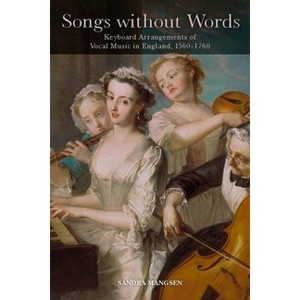
Songs Without Words - Eastman Studies in Music by Sandra Mangsen Hardcover
In Stock
Sponsored
About this item
Highlights
- Songs without Words investigates keyboard arrangements of vocal music in England, ca. 1560-1760.
- Author(s): Sandra Mangsen
- 282 Pages
- Music, History & Criticism
- Series Name: Eastman Studies in Music
Description
About the Book
Pathbreaking study of a vast and intriguing repertoire: arrangements for keyboard instruments of songs, arias, and other vocal pieces, from the age William Byrd to that of Handel.
Book Synopsis
Songs without Words investigates keyboard arrangements of vocal music in England, ca. 1560-1760. The focus is on the domestic performance of music from operas and oratorios in the eighteenth century, and the importance of well-known ballad and dance tunes for earlier composers of both virtuosic and pedagogical arrangements. Teachers, performers, and publishers at the time made little distinction between arranged and newly composed music for the keyboard. The models for these keyboard arrangements made up a shared repertoire, akin to the jazz standards of the twentieth century. In Restoration England, the ballad tradition saw tunes and texts move between oral, manuscript, and printed transmission, and from street to playhouse and back again. In the eighteenth century printed keyboard arrangements aimed at female amateurs aided in the popularization of opera. The relation between arrangements and their models, the reception, and the aesthetics of arrangements are explored in the framing chapters. Sandra Mangsen is professor emerita of music at the University of Western Ontario (London, Canada) and resides in Vermont. She is a professional harpsichordist and holds the doctorate in musicology from Cornell University.
Review Quotes
A well-documented book on a very attractive topic that is still little researched. The prose is clear and the tables are detailed and informative. [Mangsen] considers the purposes and motivations for the dissemination of arrangements in a longer chronological perspective, aligning Babell's virtuoso display with that of Liszt or Godowsky.-- "EARLY MUSIC"
Mangsen should be congratulated for her thorough investigation into such a broad subject with numerous sources of disparate natures. This repertory has not received such thoughtful interrogation in a book-length publication, and Songs without Words has taken a large step toward helping us understand the complex interweaving of theatre culture, domestic markets, social interaction, and the role of performers/composers/copyists in musical transmission between 1560 and 1760. . . . [A] valuable and significant contribution to the literature on English music and will significantly aid future examinations that further our understanding of this exciting period.-- "NABMSA REVIEWS"
Offers a useful introduction to selected repertories of vocal music arranged for keyboard in England between the sixteenth and eighteenth centuries and also charts some territory that will be unfamiliar to most readers.-- "EARLY MUSIC PERFORMER"
Sandra Mangsen brings deep and thorough research to [her] central topic. The book raises and answers questions like: What was the market for the keyboard arrangements of songs from the pop culture of the day? Did it vary by gender? Were they intended for professionals, good amateurs, or dilettantes? What purposes did these pieces serve before the age of recording? Does the absence of a song's words imply anything for performances? Should keyboard arrangements of songs be considered as important repertoire alongside original keyboard pieces? . . . Physically deluxe, . . . a nice-looking book.-- "AMERICAN RECORD GUIDE"
The subject of musical arrangement is one that has begun to arouse increasing interest among musicologists in recent years, as they have moved away from a long-standing tendency to deride such reworkings. It is thus particularly welcome that musicology's re-evaluation of arrangement as a creative activity has included a strong focus on early music, especially that of the seventeenth and eighteenth centuries. Sandra Mangsen's book is the first full-length study of the topic for the early modern period, so it forms an important addition to the field.-- "MUSIC & LETTERS"