Target New ArrivalsGift Ideas for DadClothing, Shoes & AccessoriesHome & DecorKitchen & DiningOutdoor Living & GardenGroceryHousehold EssentialsBabyBeautyPersonal CareSports & OutdoorsHealthWellnessLuggageSchool & Office SuppliesToysElectronicsVideo GamesMovies, Music & BooksParty SuppliesGift IdeasGift CardsPetsUlta Beauty at TargetShop by CommunityTarget OpticalDealsClearanceNew ArrivalsSpring OutfitsGift Ideas for MomWomen’s Festival OutfitsTop DealsTarget Circle DealsWeekly AdShop Order PickupShop Same Day DeliveryRegistryRedCardTarget CircleFind Stores
Solving, Resolving, and Dissolving Philosophical Problems - by  P M S Hacker (Paperback) - 1 of 1

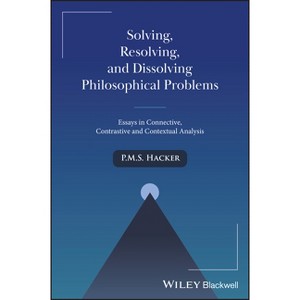
Solving, Resolving, and Dissolving Philosophical Problems - by P M S Hacker (Paperback)

$34.99

In Stock

Free & easy returns

Free & easy returns

Return this item by mail or in store within 90 days for a full refund.
Eligible for registries and wish lists

About this item

Highlights

  • Equips readers with the intellectual tools required to tackle perennial philosophical problems Solving, Resolving, and Dissolving Philosophical Problems is addressed to all who are interested in philosophical questions.
  • About the Author: P.M.S. HACKER is an Emeritus Fellow at St John's College, Oxford.
  • 256 Pages
  • Philosophy, Movements

Description


About the Book


"In this book, the author presents a series of essays that demonstrate the power and versatility of connective, contrastive, and contextual analysis, a novel and original approach to philosophical inquiry. Drawing on themes from his acclaimed tetralogy on human nature, the author shows how to solve, resolve, and dissolve philosophical problems by connecting, contrasting, and contextualizing different concepts, perspectives, and arguments. The book covers a wide range of topics, from the nature of consciousness and experience, to the place of value in a world of facts, to the problem of evil and the death of the soul. The book also includes a new essay on dreaming, as well as a comprehensive overview of the methodology of connective, contrastive, and contextual analysis. The book is written in an accessible and engaging style, with minimal technical jargon and no formal symbolism. It is suitable for anyone who is interested in philosophy and wants to learn how to think more clearly, creatively, and critically about philosophical problems"--


Book Synopsis


Equips readers with the intellectual tools required to tackle perennial philosophical problems

Solving, Resolving, and Dissolving Philosophical Problems is addressed to all who are interested in philosophical questions. It presupposes little philosophical knowledge, only curiosity and an open mind. It demands a willingness to learn not doctrine but method, and the courage to suspend judgement and to challenge received ideas.

Advocating the method of the 3 C-s: Connective, Contrastive, and Contextual Analysis, the book demonstrates the method by putting it to work -- examining fifteen salient philosophical questions that concern all thinking people. It is organized thematically into four parts. Part I introduces questions in philosophy of psychology (the nature of the mind; the mind/body problem; the nature of consciousness and its demystification; knowledge of other minds). Part II deals with epistemological questions (knowledge, belief; memory; imagination, thinking; dreaming). Part III deals with value (the roots of morality; the nature of good and evil; the need for a secular conception of the soul; happiness). The application of the method in the essays produces striking, original and unanticipated results that will give readers pause. The final part of the book articulates in detail the methodology of the 3 C-s exemplified by the fifteen essays and defends it against objections.

Solving, Resolving, and Dissolving Philosophical Problems: On the Methodology of Connective, Contrastive, and Contextual Analysis is an excellent textbook for undergraduate students in introductory philosophy courses alongside more advanced scholars, as well as an invaluable resource for educated general readers with an interest in philosophical methodology.


From the Back Cover


Equips readers with the intellectual tools required to tackle perennial philosophical problems

Solving, Resolving, and Dissolving Philosophical Problems is addressed to all who are interested in philosophical questions. It presupposes little philosophical knowledge, only curiosity and an open mind. It demands a willingness to learn not doctrine but method, and the courage to suspend judgement and to challenge received ideas.

Advocating the method of the 3 C-s: Connective, Contrastive, and Contextual Analysis, the book demonstrates the method by putting it to work - examining fifteen salient philosophical questions that concern all thinking people. It is organized thematically into four parts. Part I introduces questions in philosophy of psychology (the nature of the mind; the mind/body problem; the nature of consciousness and its demystification; knowledge of other minds). Part II deals with epistemological questions (knowledge, belief; memory; imagination, thinking; dreaming). Part III deals with value (the roots of morality; the nature of good and evil; the need for a secular conception of the soul; happiness). The application of the method in the essays produces striking, original and unanticipated results that will give readers pause. The final part of the book articulates in detail the methodology of the 3 C-s exemplified by the fifteen essays and defends it against objections.


About the Author


P.M.S. HACKER is an Emeritus Fellow at St John's College, Oxford. He is a leading authority on the philosophy of Wittgenstein. He has also written extensively on philosophy of mind, philosophy and neuroscience, and philosophy of language. He is author of 25 books and 175 papers. His most recent works are the 2nd edition of Philosophical Foundations of Neuroscience (co-authored with the great neuroscientist M. R. Bennett), his human nature tetralogy: Human Nature: the Categorial Framework; The Intellectual Powers; The Passions; The Moral Powers; and A Beginner's Guide to the Later Philosophy of Wittgenstein.

Dimensions (Overall): 9.0 Inches (H) x 6.0 Inches (W) x .54 Inches (D)
Weight: .77 Pounds
Suggested Age: 22 Years and Up
Number of Pages: 256
Genre: Philosophy
Sub-Genre: Movements
Publisher: Wiley-Blackwell
Theme: Analytic
Format: Paperback
Author: P M S Hacker
Language: English
Street Date: February 13, 2025
TCIN: 1011246257
UPC: 9781394278817
Item Number (DPCI): 247-47-5494
Origin: Made in the USA or Imported
If the item details aren’t accurate or complete, we want to know about it.

Shipping details

Estimated ship dimensions: 0.54 inches length x 6 inches width x 9 inches height
Estimated ship weight: 0.77 pounds
We regret that this item cannot be shipped to PO Boxes.
This item cannot be shipped to the following locations: American Samoa (see also separate entry under AS), Guam (see also separate entry under GU), Northern Mariana Islands, Puerto Rico (see also separate entry under PR), United States Minor Outlying Islands, Virgin Islands, U.S., APO/FPO, Alaska, Hawaii

Return details

This item can be returned to any Target store or Target.com.
This item must be returned within 90 days of the date it was purchased in store, delivered to the guest, delivered by a Shipt shopper, or picked up by the guest.
See the return policy for complete information.

Additional product information and recommendations

Discover more options

Trending Philosophy

Get top deals, latest trends, and more.

Privacy policy