Sponsored
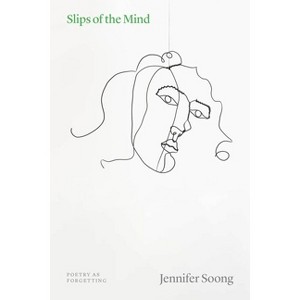
Slips of the Mind - (Thinking Literature) by Jennifer Soong
In Stock
Sponsored
About this item
Highlights
- An audacious account of what happens when forgetting becomes a way of writing and writing becomes a way of forgetting.
- About the Author: Jennifer Soong is a poet, literary critic, and assistant professor of English and Literary Arts at the University of Denver.
- 208 Pages
- Literary Criticism, Modern
- Series Name: Thinking Literature
Description
About the Book
"An audacious account of what happens when forgetting becomes a way of writing and writing becomes a way of forgetting. In Slips of the Mind, poet and critic Jennifer Soong turns away from forgetting's longstanding associations with suppression, privation, and error to argue that the absence or failure of memory has often functioned as a generative creative principle. Exploring forgetting not as the mere rejection of a literary past or a form of negative poetics, Soong puts to the test its very aesthetic meaning. What new structures, forms of desires, styles, and long and short feelings do lapses in time allow? What is oblivion's relationship to composition? And how does the twentieth-century poet come to figure as the quintessential embodiment of such questions? Soong uncovers forgetting's influence on Gertrude Stein, Lyn Hejinian, Tan Lin, Harryette Mullen, Lissa Wolsak, and New York School poets John Ashbery, James Schuyler, Bernadette Mayer, and Ted Berrigan, among others. She reveals that forgetting's shapeshifting produces differences in poetic genre, interest, and degrees of intentionality-and that such malleability is part of forgetting's nature. Most provocatively, Soong shows how losing track of things, leaving them behind, or finding them already gone resists overdetermination and causality in the name of surprise, as poets leverage forgetting in order to replace identity with style. Slips of the Mind is the kind of literary criticism that will reward all readers of modern and contemporary poetry"--
Book Synopsis
An audacious account of what happens when forgetting becomes a way of writing and writing becomes a way of forgetting.
In Slips of the Mind, poet and critic Jennifer Soong turns away from forgetting's long-standing associations with suppression, privation, and error to argue that the absence or failure of memory has often functioned as a generative creative principle. Exploring forgetting not as the mere rejection of a literary past or a form of negative poetics, Soong puts to the test its very aesthetic meaning. What new structures, forms of desires, styles, and long and short feelings do lapses in time allow? What is oblivion's relationship to composition? And how does the twentieth-century poet come to figure as the quintessential embodiment of such questions?
Soong uncovers forgetting's influence on Gertrude Stein, Lyn Hejinian, Tan Lin, Harryette Mullen, Lissa Wolsak, and New York School poets John Ashbery, James Schuyler, Bernadette Mayer, and Ted Berrigan, among others. She reveals that forgetting's shapeshifting produces differences in poetic genre, interest, and degrees of intentionality-and that such malleability is part of forgetting's nature. Most provocatively, Soong shows how losing track of things, leaving them behind, or finding them already gone resists overdetermination and causality in the name of surprise, as poets leverage forgetting in order to replace identity with style. Slips of the Mind is the kind of literary criticism that will reward all readers of modern and contemporary poetry.
Review Quotes
"Slips of the Mind is a poetics of forgetting, in which the condition is seen not merely as some regrettable lack, but rather as a positive creative principle in its own right. Soong discovers the allure of forgetting and the dazzling variety of phenomena that follow from it: formal, affective, stylistic, temporal. All of which refract back through Soong's own prismatic writing, which is moving, beautifully styled, and meticulously crafted by turns."-- "Craig Dworkin, author of "Radium of the Word""
"A memorable case for forgetting. Articulating its aesthetics neither as mental symptom nor as intellectual lapse, Soong demonstrates how cultivated oblivion and the revivifying swerves of attention it can generate become the enabling condition for a writing of enactment (rather than reportage) and the secret (lost) thread that would tie Stein to the New York School, Language writing, and Conceptualism. As Soong shows, this writing defamiliarizes our history of defamiliarization by forgetting its canonical theorists and reinventing its concerns as the problem of every actual present."-- "Lytle Shaw, author of "Narrowcast: Poetry and Audio Research""
About the Author
Jennifer Soong is a poet, literary critic, and assistant professor of English and Literary Arts at the University of Denver. She is the author of several books of poetry, including Comeback Death, Suede Mantis / Soft Rage, and the forthcoming My Earliest Person.
Shipping details
Return details
Trending Entertainment New Arrivals

Discover more options