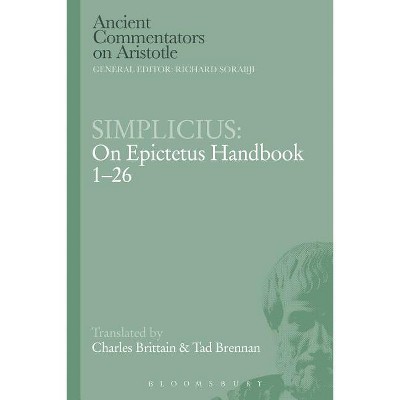
The Enchiridion or Handbook of the first-century AD Stoic Epictetus was used as an ethical treatise both in Christian monasteries and by the sixth-century pagan Neoplatonist Simplicius.
About the Author: Tad Brennan is Associate Professor at the Department of Philosophy, Yale University, USA.
240 Pages
Philosophy, History & Surveys
Series Name: Ancient Commentators on Aristotle
Description
About the Book
The "Enchiridion" or "Handbook" of the first-century AD Stoic Epictetus was used as an ethical treatise both in Christian monasteries and by the sixth-century pagan Neoplatonist Simplicius. This is the second volume of a translation of Simplicius' commentary on Epictetus' "Handbook".
Book Synopsis
The Enchiridion or Handbook of the first-century AD Stoic Epictetus was used as an ethical treatise both in Christian monasteries and by the sixth-century pagan Neoplatonist Simplicius. Simplicius chose it for beginners, rather than Aristotle's Ethics, because it presupposed no knowledge of logic. We thus get a fascinating chance to see how a pagan Neoplatonist transformed Stoic ideas. The text was relevant to Simplicius because he too, like Epictetus, was teaching beginners how to take the first steps towards eradicating emotion, although he is unlike Epictetus in thinking that they should give up public life rather than acquiesce, if public office is denied them. Simplicius starts from a Platonic definition of the person as rational soul, not body, ignoring Epictetus' further whittling down of himself to just his will or policy decisions. He selects certain topics for special attention in chapters 1, 8, 27 and 31. Things are up to us, despite Fate. Our sufferings are not evil, but providential attempts to turn us from the body. Evil is found only in the human soul. But evil is parasitic (Proclus' term) on good. The gods exist, are provident, and cannot be bought off.With nearly all of this the Stoics would agree, but for quite different reasons, and their own distinctions and definitions are to a large extent ignored. This translation of the Handbook is published in two volumes. This is the second volume, covering chapters 27-53; the first covers chapters 1-26.
About the Author
Tad Brennan is Associate Professor at the Department of Philosophy, Yale University, USA. Charles Brittain is Associate Professor at the Department of Classics, Cornell University, USA.
Dimensions (Overall): 9.21 Inches (H) x 6.14 Inches (W) x .43 Inches (D)
Weight: .64 Pounds
Suggested Age: 22 Years and Up
Number of Pages: 240
Genre: Philosophy
Sub-Genre: History & Surveys
Series Title: Ancient Commentators on Aristotle
Publisher: Bloomsbury Academic
Theme: Ancient & Classical
Format: Paperback
Author: Charles Brittain & Tad Brennan
Language: English
Street Date: April 10, 2014
TCIN: 1008779496
UPC: 9781472557360
Item Number (DPCI): 247-19-7716
Origin: Made in the USA or Imported
If the item details aren’t accurate or complete, we want to know about it.
Shipping details
Estimated ship dimensions: 0.43 inches length x 6.14 inches width x 9.21 inches height
Estimated ship weight: 0.64 pounds
We regret that this item cannot be shipped to PO Boxes.
This item cannot be shipped to the following locations: American Samoa (see also separate entry under AS), Guam (see also separate entry under GU), Northern Mariana Islands, Puerto Rico (see also separate entry under PR), United States Minor Outlying Islands, Virgin Islands, U.S., APO/FPO
Return details
This item can be returned to any Target store or Target.com.
This item must be returned within 90 days of the date it was purchased in store, shipped, delivered by a Shipt shopper, or made ready for pickup.