Sponsored
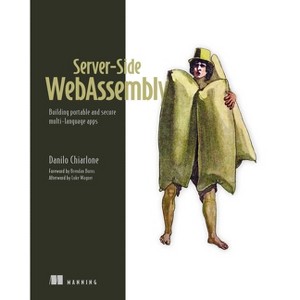
Server-Side Webassembly - by Danilo Chiarlone (Paperback)
Out of Stock
Sponsored
About this item
Highlights
- Get a free eBook (PDF or ePub) from Manning as well as access to the online liveBook format (and its AI assistant that will answer your questions in any language) when you purchase the print book.
- About the Author: Danilo Chiarlone is a champion of multiple WebAssembly System Interface Proposals, and has made significant contributions to WebAssembly with his work on projects like SpiderLightning and runwasi.
- 272 Pages
- Computers + Internet, Cloud Computing
Description
Book Synopsis
Get a free eBook (PDF or ePub) from Manning as well as access to the online liveBook format (and its AI assistant that will answer your questions in any language) when you purchase the print book.
"WebAssembly on the server is the future of computing."
-Solomon Hykes, founder of Docker
Learn how to harness the power of Wasm on the application back-end. By following the numerous practical examples and crystal-clear explanations, you'll soon be seeing the benefits of reduced cold start times, improved security and performance, and the freedom of polyglot programming.
This book lays out everything you need to take WebAssembly beyond its traditional browser domain. You'll put on the hats of a systems architect, a backend developer, and even a DevOps engineer to get a full picture of WebAssembly development from both an architecture and development perspective.
Inside Server-Side WebAssembly you'll learn how to:
- Develop and deploy server-side Wasm applications
- Create and manage Wasm containers with OCI
- Compile Wasm components from multiple languages
- Scale Wasm applications using Kubernetes
- Deploy Wasm applications across different environments
- Integrate with databases and machine learning
About the technology
WebAssembly (Wasm) revolutionized frontend development by enabling secure, high-performance code in the browser. Now it's doing the same for backend infrastructure as a platform for lightweight, portable applications that run anywhere. In this book, you'll learn how to build production-grade server-side apps using Wasm.
About the book
Server-Side WebAssembly teaches you to use WebAssembly components and the WebAssembly System Interface (WASI) to build web back ends. You'll start with Wasm fundamentals and then quickly start building a realistic content management system complete with data storage, HTTP servers, and AI-generated content. As you go, you'll see how Wasm integrates code from multiple languages and connects naturally with databases, AI/ML systems, and deployment platforms like Kubernetes.
What's inside
- Integrate components from multiple languages
- Deploy Wasm applications on Kubernetes
- Connect Wasm apps to databases and ML systems
About the reader
For intermediate web developers. Code samples in Rust, JavaScript and Python.
About the author
Danilo Chiarlone works at Microsoft on cloud and virtualization technologies and is a contributor to several WebAssembly System Interface (WASI) proposals.
Table of Contents
Part 1
1 Introducing Wasm on the server
2 Building server-side applications with Wasm modules
3 Enhancing portability and security with Wasm components
4 Interfacing Wasm with the underlying system
5 From machine learning to databases: Applications of Wasm
Part 2
6 Creating production-grade Wasm applications
7 Introducing Wasm containers
8 Scalability for Wasm with Kubernetes
9 The future of Wasm
A Required tools
B Deploying the SmartCMS to Azure Kubernetes Service
About the Author
Danilo Chiarlone is a champion of multiple WebAssembly System Interface Proposals, and has made significant contributions to WebAssembly with his work on projects like SpiderLightning and runwasi. Danilo is also a passionate educator, offering free lessons on Rust and WebAssembly through his YouTube channel and delivering multiple presentations at events such as CloudNative Rejekts, WasmCon, and RustGlobal. Danilo works at Microsoft, where he focuses on increasing WebAssembly security through hardware virtualization and enabling the next wave of serverless and edge computing applications.