Sponsored
About this item
Highlights
- A new, naturalistic theory of consciousness and sensory experience.
- About the Author: Paul G. Skokowski is executive director and cofounder of the Center for the Explanation of Consciousness at Stanford University and a fellow in philosophy at St. Edmund Hall, University of Oxford.
- 240 Pages
- Philosophy, Mind & Body
Description
About the Book
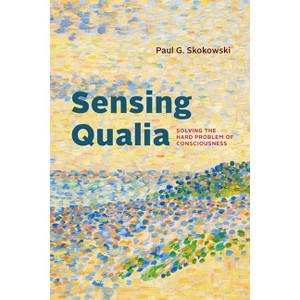
"Accounting for qualia in the natural world has come to be known as the hard problem of consciousness. Qualia are the 'raw feels' of consciousness and make up the contents of our sensory experience. These include colors, tastes, pains, smells, and other sensory phenomena. In Sensing Qualia, philosopher Paul Skokowski helps us understand qualia through sensory naturalism, a theory that recognizes our senses as detectors of physical properties in the world. Drawing on neuroscience, physics, cognitive science, and philosophy, Skokowski provides a materialist framework for studying qualia in the physical world and explores the naturalistic limits for qualia in androids and AI. The first part of Sensing Qualia brings readers up to speed with the problem of qualia by examining some of the most influential theories of mind since Descartes. This accessible overview prepares readers for the arguments surrounding qualia and conscious experience that comprise the rest of the book. As a whole, Sensing Qualia provides a compelling explanation of qualia for anyone who is curious about the nature of conscious experience"--
Book Synopsis
A new, naturalistic theory of consciousness and sensory experience.
Philosophers of mind and neuroscientists often debate what they call the hard problem of consciousness, that is, how we might account for qualia-our subjective experiences of phenomena like color, taste, pain, smell, and more. In Sensing Qualia, Paul G. Skokowski surveys the most influential theories of mind since Descartes in order to establish a new theory he calls sensory naturalism, which recognizes the senses as natural detectors of physical properties in the world.
Drawing on neuroscience, physics, and philosophy, Skokowski provides a naturalistic framework for studying qualia in the physical world and explores the limits of qualia in androids and AI. The result is a compelling explanation of qualia for anyone curious about the nature of conscious experience in humans and AI.
Review Quotes
"Sensing Qualia slays the philosophical monsters of swampmen, zombies, and other threats to materialism that may arise from the existence of qualia. With clear prose and no-nonsense arguments, Skokowski takes us on an entertaining tour of philosophy of mind."--Craig Callender, University of California, San Diego
"Skokowski offers a marvelously comprehensive and accessible account of the debate over consciousness--with insights about history, integrated information theory, quantum mechanics, and AI. Along the way, he gives us his externalist account of qualia, arguing that it makes qualia compatible with materialism."--Frank Jackson, Australian National University
"Skokowski tackles some of the toughest questions in philosophy of mind. Tracing centuries of debate and critiquing today's leading theories, he introduces a powerful new framework for understanding our subjective experience. A rigorous and groundbreaking work, this book will reshape how we all think about mind and matter."--David Eagleman, Stanford University
"Where is that conscious you in the brain? Philosophers and scientists have tripped over each other for millennia trying to capture the idea of you in tractable terms. I highly recommend Skokowski's wonderfully lucid yet detailed account of this debate. Reviewing theories of how the brain enables the ineffable you, Skokowski also gratifyingly proposes an actual biological mechanism. A must-read!"--Michael S. Gazzaniga, University of California, Santa Barbara
About the Author
Paul G. Skokowski is executive director and cofounder of the Center for the Explanation of Consciousness at Stanford University and a fellow in philosophy at St. Edmund Hall, University of Oxford. He is editor of Information and Mind.
Shipping details
Return details
Trending Book Pre-Orders






Discover more options