Sponsored
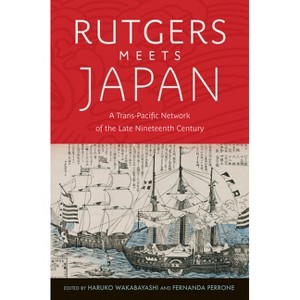
Rutgers Meets Japan - Ceres: Rutgers Studies in History by Haruko Wakabayashi & Fernanda Perrone Paperback
Pre-order
Sponsored
About this item
Highlights
- In 1867 Kusakabe Taro, a young samurai from Fukui, Japan, began studying at Rutgers as its first foreign student.
- About the Author: HARUKO WAKABAYASHI is an associate teaching professor in the Department of Asian Languages and Cultures at Rutgers-New Brunswick.
- 368 Pages
- History, Asia
- Series Name: Ceres: Rutgers Studies in History
Description
About the Book
In 1867 Kusakabe Taro, a young samurai from Fukui, Japan, began studying at Rutgers as its first foreign student. Three years later, in 1870, his former tutor, friend, and Rutgers graduate, William Elliot Griffis, left for Japan to teach English and science. Griffis and Kusakabe were a small piece of a vast transnational network of leading modernizers of Japan in the 1860s and 70s. Through contributions from scholars and archivists in the U.S., Canada, and Japan, Rutgers Meets Japan aims to reconstruct these early Rutgers-Japan connections.
Book Synopsis
In 1867 Kusakabe Taro, a young samurai from Fukui, Japan, began studying at Rutgers as its first foreign student. Three years later, in 1870, his former tutor, friend, and Rutgers graduate, William Elliot Griffis, left for Japan to teach English and Science for three and a half years. The year 2020 marked the 150th anniversary of two landmark events in the history of the Rutgers-Japan relationship: the untimely death of Kusakabe only weeks before his graduation, and his friend Griffis' departure to Japan.
Griffis and Kusakabe were only a small piece of a vast transnational network of leading modernizers of Japan in the 1860s and 70s. The Japanese students in New Brunswick were young and innovative men of samurai and aristocratic lineage, who were sent by reform-minded leaders of Japan, which was undergoing a dramatic transformation. They came to New Brunswick seeking Western knowledge that was much needed for the modernization of a newly forming nation. New Brunswick became the hub of a network of Japanese nationals that extended to the major cities of New York, Philadelphia, and Boston, and from there to the smaller towns of New England. Once in New Brunswick, these Japanese students were embraced by Protestant ministers, educators, and missionaries--both men and women--whose network encompassed Rutgers College and the neighboring New Brunswick Theological Seminary, and which stretched to Dutch Reformed parishes throughout the Eastern seaboard, and westward as far as the Dutch enclave of Holland, Michigan. Meanwhile, the American teachers and missionaries who left for Japan became part of a network of reformist leaders and Japanese returnees that extended to schools, colleges, and missions in Japan, and formed the foundations of Japan's modern educational system. Through contributions from scholars and archivists in the U.S., Canada, and Japan, Rutgers Meets Japan aims to reconstruct the early Rutgers-Japan connections and examine the role and impact of this transnational network on Japan and the U.S. in the late nineteenth century.
Review Quotes
"Based on careful archival research, this book presents a compelling picture of a transpacific network between the U.S. and Japan. Among the signal contributions of this work is its engaging and poignant discussion of the experiences of both Japanese students on the Eastern Seaboard and American missionaries in Japan in the decades after the opening of the Japanese treaty ports."
--Steven J. Ericson "author of The Sound of the Whistle: Railroads and the State in Meiji Japan" (6/6/2025 12:00:00 AM)
"By tracing the lives of key figures and formative themes in unprecedented detail, Rutgers Meets Japan demonstrates the singular role Rutgers played in the formative years of Japanese modernization, and by extension its importance in developing Japan-U.S. relations more broadly. The book stands alone, providing its own timely and unique contribution to our knowledge of Japan-U.S. relations."--Andrew Cobbing "associate professor of history, University of Nottingham" (6/6/2025 12:00:00 AM)
About the Author
HARUKO WAKABAYASHI is an associate teaching professor in the Department of Asian Languages and Cultures at Rutgers-New Brunswick. She is the author of The Seven Tengu Scrolls: Evil and the Rhetoric of Legitimacy in Medieval Japanese Buddhism.
FERNANDA PERRONE is the Archivist and Head of the Exhibitions Program and Curator of the William Elliot Griffis Collection, Special Collections/University Archives at Rutgers University. She is the co-author of The Douglass Century: The Transformation of the Women's College at Rutgers (Rutgers University Press).
Shipping details
Return details
Frequently bought together






Guests also viewed




Discover more options