Sponsored
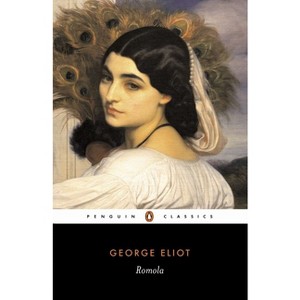
Romola - (Penguin Classics) by George Eliot (Paperback)
In Stock
Sponsored
About this item
Highlights
- One of George Eliot's most ambitious and imaginative novels--the story of a young woman's intellectual and spiritual awakening in Renaissance Florence Romola is set during the turbulent years following the expulsion of the powerful Medici family.
- About the Author: George Eliot (1819-1880), is the author of Adam Bede (1859), The Mill on the Floss (1860), Silas Mariner (1861) and Middlemarch (1872).
- 688 Pages
- Fiction + Literature Genres, Classics
- Series Name: Penguin Classics
Description
Book Synopsis
One of George Eliot's most ambitious and imaginative novels--the story of a young woman's intellectual and spiritual awakening in Renaissance Florence
Romola is set during the turbulent years following the expulsion of the powerful Medici family. At its heart is Romola, the devoted daughter of a blind scholar, married to the clever but ultimately treacherous Tito. Her husband's duplicity in both love and politics threatens to destroy everything she values, and she must break away to find her own path in life. Described by Eliot as "written with my best blood," Romola is a compelling portrayal of a Utopian heroine, played out against a turbulent historical backdrop.
In her introduction, Dorothea Barrett examines Eliot's life and literary career, and issues of gender, language and history. This edition also includes further reading, glossaries and notes.
From the Back Cover
'There is no book of mine about which I more thoroughly feel that I swear by every sentence as having been written with my best blood.'. So wrote George Eliot of Romola, the novel which argues her most profound and utopian vision of the position of women. Romola's patient subservience to her scholar-father Bardo, her unhappy marriage to supple and treacherous Tito, and her passionate intellectual and spiritual awakening take place in Renaissance Florence which, like Victorian Britain, was caught up in a period of ferment and transition. Romola appeared in 1862-3 to high praise by Victorians from Tennyson and Trollope to Henry James, and discerning modern readers will recognize it as George Eliot's first mature masterpiece. In her introduction to this new edition, Dorothea Barrett explores the issues of gender and learning, desire and scholarship, and the interweaving of history and fiction which she identifies at the centre of the novel.
Review Quotes
"George Eliot's humanity colors all her other gifts--her humor, her morality, and her exquisite rhetoric." --Henry James
About the Author
George Eliot (1819-1880), is the author of Adam Bede (1859), The Mill on the Floss (1860), Silas Mariner (1861) and Middlemarch (1872). Dorothea Barrett received her PhD in Literature from Cambridge University (UK). She has been teaching for NYU in Florence since the Fall 2001 and offers "Postmodern Fiction: International Perspective" and "Survey of Modern Italian Literature".
Shipping details
Return details
Frequently bought together
Guests also viewed
Discover more options