Sponsored
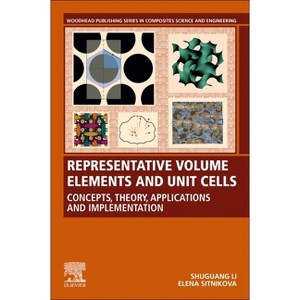
Representative Volume Elements and Unit Cells - Woodhead Publishing Composites Science and Engineering by Shuguang Li & Elena Sitnikova
In Stock
Sponsored
About this item
Highlights
- Numerical methods to estimate material properties usually involve analysis of a representative volume element (RVE) or unit cell (UC).
- About the Author: Shuguang Li, Professor of Aerospace Composites, the Institute for Aerospace Technology, Faculty of Engineering, University of Nottingham, UK.
- 482 Pages
- Technology, Materials Science
- Series Name: Woodhead Publishing Composites Science and Engineering
Description
Book Synopsis
Numerical methods to estimate material properties usually involve analysis of a representative volume element (RVE) or unit cell (UC). The representative volume element (RVE) or unit cell (UC) is the smallest volume over which a measurement can be made that will yield a value representative of the whole. RVEs and UCs are widely used in the characterisation of materials with multiscale architectures such as composites. However, finite element (FE) software packages such as Abaqus and Comsol MultiPhysics do not offer the capability for RVE and UC modelling directly on their own. To apply them to analyse RVEs and UCs, the generation of the FE models for them, the imposition of boundary conditions, and the extraction of directly relevant results are essentially the responsibility of the user. These have tended to be incorrectly implemented by users! For the first time, this book will provide a comprehensive account on correct modelling of RVEs and UCs, which will eliminate any uncertainties and ambiguities.The book offers a complete and thorough review on the subject of RVEs and UCs, establishing a framework on a rigorous mathematical and mechanical basis to ensure that basic concepts, such as symmetry and free body diagrams, are applied correctly and consistently. It also demonstrates to readers that rigorous applications of mathematics and mechanics are meant to make things clear, consistent, thorough and, most of all, simple and easy to follow, rather than the opposite as many perceive. As a result, the book shows that the appropriate use of RVEs and UCs can deliver an effective and reliable means of material characterisation. It not only provides a much needed comprehensive account on material characterisation but, more importantly, explains how such characterisation can be conducted in a consistent and systematic manner. It also includes a ready-to-use open source code for UCs that can be downloaded from a companion site for potential users to utilise, adapt and expand as they wish.
About the Author
Shuguang Li, Professor of Aerospace Composites, the Institute for Aerospace Technology, Faculty of Engineering, University of Nottingham, UK. He was awarded BEng and MEng from Nanjing University of Aeronautics and Astronautics (NUAA), China in 1982 and 1984, respectively. His first academic career was at NUAA between 1984 and1988 as a lecturer. He then obtained his PhD from the University of Manchester in 1993. He returned back to his academic track as a lecturer at the University of Manchester in 1995 and was appointed to his present position in 2012.
Professor Li was one of the two advisors to the 2nd World Wide Failure Exercise for Polymer Composites (on 3D failure theories). He is one of the organisers for the 3rd Exercise of the same (on damage theories). The outcomes have been published in Journal of Composite Materials. He is on the editorial board of the International Journal of Mechanical Sciences. He is a visiting professor of NUAA and Zhejiang University, China. He is one of the Qinling Experts at AVIC Aircraft Strength Research Institute and a Technical Advisor to Sinoma Science and Technology, China.
Professor Li has published well over 100 academic papers, most of them in highly reputable international journals. His main research interest is in the area of analysis of composite materials and structures, in particular, on modelling damage and failure, micromechanics and material characterization. As an outcome of his research on micromechanical modelling of composites, a piece of software UnitCells(c) has been commercialized which offers material scientists and structural designers a useful tool for characterisation of composites in terms of effective elastic properties as well as strength properties.
Shipping details
Return details
Trending Computers & Technology Books