Sponsored
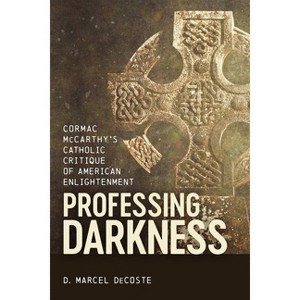
Professing Darkness - by D Marcel DeCoste (Hardcover)
In Stock
Sponsored
About this item
Highlights
- Professing Darkness confirms the centrality of Catholic thought, imagery, and sacrament to the spiritual and ethical outlook of the work of Cormac McCarthy and, more specifically, its consistent assessment of Enlightenment values and their often-catastrophic realization in American history.
- About the Author: D. Marcel DeCoste, professor of English at the University of Regina, is the author of The Vocation of Evelyn Waugh: Faith and Art in the Post-War Fiction.
- 284 Pages
- Literary Criticism, Subjects & Themes
Description
About the Book
"Professing Darkness: Cormac McCarthy's Catholic Critique of American Enlightenment establishes the centrality of Catholic thought, imagery, and sacrament both to the spiritual outlook of the McCarthy corpus and, more specifically, to its critique of Enlightenment values and their realization in American history. To this end, D. Marcel DeCoste surveys McCarthy's fiction from both his Tennessee and southwestern periods, with chapters devoted to eight of his published novels-from Outer Dark to The Road-and an introduction and coda that offer analyses of two of his dramatic works, along with his final novels, The Passenger and Stella Maris. The argument advanced by DeCoste is twofold. First, his readings demonstrate that McCarthy's work mounts a sustained critique of core Enlightenment values and their bloody results in the American context. Second, he establishes that this critical engagement with American Enlightenment is one enabled by, and articulated through, specifically Catholic teachings on such topics as sacraments, ethics, and material creation. Though other studies trace how McCarthy's fiction dissects such American myths as radical individualism and Manifest Destiny, they do not, at the same time, take up the question of how the fiction's spiritual interests and obtrusive Christian symbolism relate to this critical project. More than merely calling attention to McCarthy's own religious background or his drawing on sacramental language, DeCoste examines the significance of Catholicism to the author's depictions not just of religion and ethics, but of the modernity many critics see McCarthy as critiquing. Throughout Professing Darkness, DeCoste offers extended analysis of McCarthy's engagement with American history and myth, early modern and Enlightenment thought, and Catholic theology, ethics, and sacramentalism"--
Book Synopsis
Professing Darkness confirms the centrality of Catholic thought, imagery, and sacrament to the spiritual and ethical outlook of the work of Cormac McCarthy and, more specifically, its consistent assessment of Enlightenment values and their often-catastrophic realization in American history. D. Marcel DeCoste surveys McCarthy's fiction from both his Tennessee and Southwest periods, with chapters devoted to eight of his published novels--from Outer Dark to The Road--and a conclusion that examines the writer's screenplay for The Counselor and the duology of The Passenger and Stella Maris.
DeCoste's attentive, wide-ranging interpretations demonstrate that McCarthy's work mounts a sustained critique of core Enlightenment ideals and their devastating results in the American context, especially for Indigenous peoples, the environment, the viability of community, and the integrity of a self irreducible to the status of a commodity. Professing Darkness shows that Roman Catholic understandings of Penance and Eucharist, along with specific Catholic teachings--such as those regarding the goodness of Creation, the nature of evil, the insufficiency of the self, and the radical invitation to conversion--enable McCarthy's revelatory engagement with American Enlightenment.
An important contribution to the ever-expanding critical literature on a towering contemporary author, Professing Darkness offers an innovative reading of both the spiritual and political valences of McCarthy's writing.
Review Quotes
"This book is indispensable for both McCarthy scholars and those interested in the interplay between faith and literature in its consideration of the indelible imprint that McCarthy's Catholic childhood left upon him. It skillfully reveals how that foundational faith and training manifest themselves subtly throughout his writing."--Scott D. Yarbrough, coeditor of Carrying the Fire: Cormac McCarthy's "The Road" and the Apocalyptic Tradition
"Thoroughly researched, persuasively argued, and elegantly written, this groundbreaking and fruitful monograph fulfills its ambition to establish Cormac McCarthy as a thinker profoundly influenced by primary Roman Catholic ideas that pervade and inform his work."--Russell M. Hillier, author of Morality in Cormac McCarthy's Fiction: Souls at Hazard
About the Author
D. Marcel DeCoste, professor of English at the University of Regina, is the author of The Vocation of Evelyn Waugh: Faith and Art in the Post-War Fiction.
Shipping details
Return details
Frequently bought together
Discover more options