Sponsored
In Stock
Sponsored
About this item
Highlights
- While posthumanism has gained traction over the past few decades, its application has, so far, mostly been within the humanities.
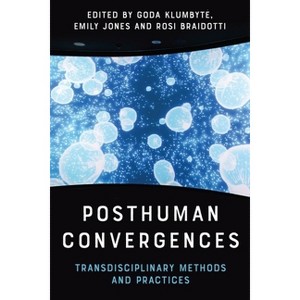
- Author(s): Goda Klumbyte & Emily Jones & Rosi Braidotti
- 408 Pages
- Philosophy, Movements
Description
About the Book
Indexes new and emerging trends in both transdisciplinary and posthuman research.
Book Synopsis
While posthumanism has gained traction over the past few decades, its application has, so far, mostly been within the humanities. This volume brings together a collection of researchers working both within the humanities and beyond, including in marine biology, computer science, the social sciences, legal studies, decolonial studies, pedagogies, and nursing practice, to focus on methods and practices that showcase how to do transdisciplinary posthuman work.
At a time where the humanities are in question, with multiple departments and faculties being shut down or drastically cut in size, Posthuman Convergences provides a strong example of exactly why the humanities are so vital in the contemporary moment. It showcases a series of ways to help us think differently about the most pressing problems of our times.
Review Quotes
This book is a must. It is a cri de coeur for the humanities, showcasing not only their relevance of the humanities in the contemporary university but also their contribution to society. The volume demonstrates the importance of the mathematical and aesthetic imagination in providing new and critical ways of seeing the world and addressing the urgent problems engendered by the historical conditions of our meltdown age. It is precisely in the crossroads between a different sense of the mathematical and a renewed practice of critique & qualitative approaches where the fate of our world will be decided.--Oscar Guardiola-Rivera, Birkbeck College, University of London
Posthuman Convergences, inspired by Rosi Braidotti's capacious vision for the posthumanities, argues for the necessity of the transversal, anticolonial, environmental, material, and feminist humanities. The wildly divergent essays undertake transdisciplinary methodological experiments, creative practices, and open dialogues, urging us to revitalize modes of inquiry essential for this perilous and precarious moment.--Stacy Alaimo, University of Oregon
Shipping details
Return details
Frequently bought together
Discover more options