Sponsored
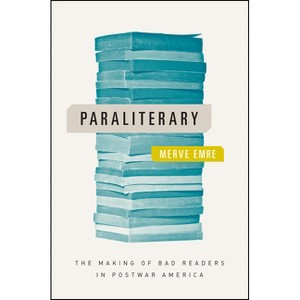
Paraliterary - by Merve Emre Paperback
$30.00
In Stock
Eligible for registries and wish lists
Sponsored
About this item
Highlights
- Literature departments are staffed by, and tend to be focused on turning out, "good" readers--attentive to nuance, aware of history, interested in literary texts as self-contained works.
- About the Author: Merve Emre is the Shapiro-Silverberg Professor of Creative Writing and Criticism at Wesleyan University and the Director of the Shapiro Center for Creative Writing and Criticism.
- 304 Pages
- Literary Criticism, American
Description
About the Book
You might think that any reader is a good reader (publishers certainly do). Merve Emre's tongue-in-cheek subtitle calls out "bad" readers--the kind whose approach to literature is naive, superficial, therapeutic, or escapist, at least in the eyes of scholars. They are not properly "literary" readers--not by the standards of university literature classrooms through most of the postwar era. Rather, bad readers read novels, stories, and poems for more vulgar reasons: to be instructed, improved, moved, even to feel civically engaged. In this book, Emre suggests that we think of bad readers not as non-literary but as "paraliterary," forged in institutions that have promoted literacy and writing well outside literature departments throughout the postwar period. Emre examines the rise of paraliterary reading and its role in helping readers acclimate to the rise of American power from the years just before World War II through the Cold War. While university literature departments were turning out good readers by the hundreds, other institutions--diplomatic missions, cultural exchange programs, multinational corporations, global activist groups--trained a vastly greater number of bad readers: diplomats, debutantes, tourists, and magazine subscribers. Emre's book explores a series of fascinating questions about American culture during this era: How did women's colleges teach students like Mary McCarthy and Jacqueline Kennedy to read novels? What hopes did idealistic Fulbright Scholars like Alfred Kazin and F. O. Matthiessen, enlisted to teach American Studies in Europe, carry with them? How did American Express become such a touchstone, both for the counterculture and family-oriented readers? The result is an invigorating and original look at the cultural life of reading during America's postwar ascendancy.
Book Synopsis
Literature departments are staffed by, and tend to be focused on turning out, "good" readers--attentive to nuance, aware of history, interested in literary texts as self-contained works. But the vast majority of readers are, to use Merve Emre's tongue-in-cheek term, "bad" readers. They read fiction and poetry to be moved, distracted, instructed, improved, engaged as citizens. How should we think about those readers, and what should we make of the structures, well outside the academy, that generate them?
We should, Emre argues, think of such readers not as non-literary but as paraliterary--thriving outside the institutions we take as central to the literary world. She traces this phenomenon to the postwar period, when literature played a key role in the rise of American power. At the same time as American universities were producing good readers by the hundreds, many more thousands of bad readers were learning elsewhere to be disciplined public communicators, whether in diplomatic and ambassadorial missions, private and public cultural exchange programs, multinational corporations, or global activist groups. As we grapple with literature's diminished role in the public sphere, Paraliterary suggests a new way to think about literature, its audience, and its potential, one that looks at the civic institutions that have long engaged readers ignored by the academy.
Review Quotes
"Merve Emre'sParaliterary is, in its author's words, a book about 'bad readers and the institutions that spawned them in postwar America' [...] One ofParaliterary's strengths is that its arguments also look beyond the particular instances it explores. This study shows that, to borrow from Jimmy inYesterday Will Make You Cry, there are a 'million more' types of bad reader still to be reclaimed."-- "The Cambridge Quarterly"
"Paraliterary engages in an equally improbable act of empathy--in her case, with uses of literature that academics usually disavow. Most English professors bridle when we're asked to read a Shakespeare sonnet at a wedding; to name our favorite character; to take a snapshot of a tourist in front of a famous writer's birthplace. We spend our lives cajoling students to stop reading for the plot or the moral or to identify with characters. Emre, in contrast, has time for the "'bad' readers who lurk outside the classroom"--and, perhaps, even for the bad reader who lurks inside every off-duty literary critic. Ranging from coeds' elocution to Fulbright fashion shoots, her quirkily juxtaposed case studies show literature to have played a central role in the 20th-century United States' relation to Europe. I came away persuaded that literary critics should study the paraliterary instead of--or at least in addition to--being embarrassed by it. If you're a bad reader trying to be good, or a good reader embracing your inner badness, this is the book for you."-- "Leah Price, Public Books Public Picks 2018"
"Paraliterary does for the history, theory, and practice of reading in the late twentieth century what The Program Era did for writing: profoundly upend what we thought we knew about how institutions other than the university have shaped our culture and our engagement with it. Merve Emre's book is essential reading for scholars of post45 and anyone else who wants to understand where our assumptions about literary fiction come from and how we came to take them as self-evident."-- "Deborah Nelson, University of Chicago"
"Paraliterary represents a major work of scholarship. A product of innovative conceptualization, deep research, and keen critical insight, this book will have a significant impact on several fields of literary study and cultural history. Scholars of American literature, of the cultural Cold War, of the sociology of literature, and of literary theory will be discussing it intently and referring to it often for years to come."-- "Sean McCann, Wesleyan University"
"If Emre's book succeeds in bringing the term paraliterary into wide circulation....she will have done scholars a service....what feels really new about Paraliterary is its insistence that the difference between literary and paraliterary readers does not map onto a familiar division between elite and popular audiences."-- "American Literary History"
"Its intellectual moves (which are many, subtle, and a pleasure to follow) are harder to categorize. . .Her concern with bad readers remains low-key, non-redemptive. It never swells into full-blown anti-elitism, which as we have learned is a weapon that is liable to explode in your hands. . .None of her bad readers could have written this very good book."-- "Los Angeles Review of Books"
"There have always been bad readers, but as Merve Emre's fascinating and highly astute new book Paraliterary demonstrates, the particular classes and types of bad readers that were made as part of postwar American diplomatic efforts necessitate a full-scale reconstruction and reconsideration. She neither apologizes for nor laments them, but rather, takes their existence as a point of departure for a wide-ranging synthesis of deep archival research and cutting-edge polemic. . . remarkably diverse and yet conceptually entwined chapters. . .are highly original and inventive."-- "Modernism/modernity"
"What makes Paraliterary particularly exciting is that its implications reach far beyond the tiny world of literary theory. Although most of the text is guided by descriptive protocol, 'we, as critics, must proudly claim the bad readers as our own if we wish to make claims about reading at all.' Emre believes this requires a survey of the institutional and geopolitical forces that created bad readers, along with an exploration of the distinctions between paraliterature and literature, if such distinctions exist. . . . This is genuine ambition from a younger scholar in a field that has a reputation for stifling it."-- "Virginia Quarterly Review"
"Widens the range of sites where we can see criticism taking place. . . is chronologically as well as methodologically expansive: because the paraliterary seems to operate by means of institutional forces, it floats outside of strong historical periodizations. What unites Paraliterary's diverse case studies is her insight that academic criticism justifies its methods by the type of subjects that it produces."-- "Andy Hines, Public Books"
About the Author
Merve Emre is the Shapiro-Silverberg Professor of Creative Writing and Criticism at Wesleyan University and the Director of the Shapiro Center for Creative Writing and Criticism. Her books include Paraliterary: The Making of Bad Readers in Postwar America, The Personality Brokers (selected as one of the best books of 2018 by the New York Times, The Economist, NPR, and The Spectator), The Ferrante Letters (winner of the 2021 PROSE award for literature), and The Annotated Mrs. Dalloway. She has been awarded the Philip Leverhulme Prize, the Robert B. Silvers Prize for Literary Criticism, and the Nona Balakian Citation for Excellence in Reviewing by the National Book Critics Circle. She is a contributing writer at The New Yorker.
Dimensions (Overall): 8.9 Inches (H) x 5.9 Inches (W) x .7 Inches (D)
Weight: .85 Pounds
Suggested Age: 22 Years and Up
Number of Pages: 304
Genre: Literary Criticism
Sub-Genre: American
Publisher: University of Chicago Press
Theme: General
Format: Paperback
Author: Merve Emre
Language: English
Street Date: November 16, 2017
TCIN: 1006094434
UPC: 9780226473970
Item Number (DPCI): 247-36-4593
Origin: Made in the USA or Imported
If the item details aren’t accurate or complete, we want to know about it.
Shipping details
Estimated ship dimensions: 0.7 inches length x 5.9 inches width x 8.9 inches height
Estimated ship weight: 0.85 pounds
We regret that this item cannot be shipped to PO Boxes.
This item cannot be shipped to the following locations: American Samoa (see also separate entry under AS), Guam (see also separate entry under GU), Northern Mariana Islands, Puerto Rico (see also separate entry under PR), United States Minor Outlying Islands, Virgin Islands, U.S., APO/FPO
Return details
This item can be returned to any Target store or Target.com.
This item must be returned within 90 days of the date it was purchased in store, shipped, delivered by a Shipt shopper, or made ready for pickup.
See the return policy for complete information.
Frequently bought together

$10.40
MSRP $17.95
$11.37 - $16.50
MSRP $18.99 - $30.00
4.4 out of 5 stars with 23 ratings

$9.99 - $21.99
$37.00 - $120.00
Trending Paperback Books

$9.85 - $23.49
MSRP $15.99 - $32.99
4.8 out of 5 stars with 157 ratings
$15.99 - $20.58
MSRP $19.99 - $30.00
5 out of 5 stars with 9 ratings
Discover more options
$28.99 - $75.99
MSRP $32.00 - $75.00
$15.80
MSRP $16.00
$21.99
MSRP $24.47