Sponsored
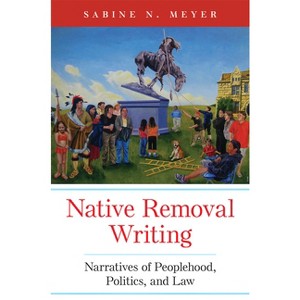
Native Removal Writing - American Indian Literature and Critical Studies by Sabine N Meyer Hardcover
In Stock
Sponsored
About this item
Highlights
- During the Standing Rock Sioux protest against the Dakota Access Pipeline, an activist observed, "Forced removal isn't just in the history books.
- Author(s): Sabine N Meyer
- 306 Pages
- Literary Criticism, Native American
- Series Name: American Indian Literature and Critical Studies
Description
About the Book
Placing novels in conversation with nonfiction writings, Native Removal Writing ranges from texts produced in response to the legal and political struggle over Cherokee Removal in the late 1820s and 1830s, to works written by African Cherokee writers dealing with the freedmen disenrollment crisis, to contemporary speculative fiction that links the appropriation of Native intangible property (culture) with the earlier dispossession of their real property (land).
Book Synopsis
During the Standing Rock Sioux protest against the Dakota Access Pipeline, an activist observed, "Forced removal isn't just in the history books." Sabine N. Meyer concurs, noting the prominence of Indian Removal, the nineteenth-century policy of expelling Native peoples from their land, in Native American aesthetic and political praxis across the centuries. Removal has functioned both as a specific set of historical events and a synecdoche for settler colonial dispossession of Indigenous communities across hemispheres and generations. It has generated a plethora of Native American writings that negotiate forms of belonging--the identities of Native collectives, their proprietary relationships, and their most intimate relations among one another. By analyzing these writings in light of domestic settler colonial, international, and tribal law, Meyer reveals their coherence as a distinct genre of Native literature that has played a significant role in negotiating Indigenous identity.
Critically engaging with Native Removal writings across the centuries, Meyer's work shows how these texts need to be viewed as articulations of Native identity that respond to immediate political concerns and that take up the question of how Native peoples can define and assert their own social, cultural, and legal-political forms of living, being, and belonging within the settler colonial order. Placing novels in conversation with nonfiction writings, Native Removal Writing ranges from texts produced in response to the legal and political struggle over Cherokee Removal in the late 1820s and 1830s, to works written by African-Native writers dealing with the freedmen disenrollment crisis, to contemporary speculative fiction that links the appropriation of Native intangible property (culture) with the earlier dispossession of their real property (land).
In close, contextualized readings of John Rollin Ridge, John Milton Oskison, Robert J. Conley, Diane Glancy, Sharon Ewell Foster, Zelda Lockhart, and Gerald Vizenor, as well as politicians and scholars such as John Ross, Elias Boudinot, and Rachel Caroline Eaton, Meyer identifies the links these writers create between historical past, narrated present, and political future. Native Removal Writing thus testifies to both the ongoing power of Native Removal writing and its significance as a critical practice of resistance.
Review Quotes
"One of the greatest benefits for readers is the way Meyer is drawing their awareness to Indigenous literary participation in legal discourses. Meyer provides concise comparative readings of highly complex novels against the backdrop of even more complex historical-legal realities, making Native Removal Writing a rich archive of knowledge for any American studies scholar, whether specializing in Indigenous literatures or not."--American Studies Journal
"This book is a good introduction to lesser-known writings and would serve well as a foundational text for courses on Removal and on literature of the "southeastern" tribes, and could be a good accompaniment for studies of law and Indigenous nationhood/peoplehood."--Great Plains Quarterly
"Sabine Meyer asks a crucial question: what would her literary-legal critical approach mean to Native audiences? It means insightful perspectives on Native writers' anti-colonialist confrontations of Removal, from the thick of the conflict in the nineteenth century up to our present moment. It means accountability, both for historical patterns that Native people today might want to correct and for Meyer's own scholarship in relation to Native communities. Most encouragingly, it means emboldened senses of agency and imagination."--Joshua B. Nelson, author of Progressive Traditions: Identity in Cherokee Literature and Culture
"Native Removal Writing showcases cogent synthesis of legal history and literary theory. The author's inclusion of Afro-Native texts is an important, intersectional move. This is a book that readers new to the field can start with, but that experts will also learn from. It is admirably written and a contribution to indigenous law and literature."--David J. Carlson, author of Imagining Sovereignty: Self-Determination in American Indian Law and Literature
"Native Removal Writing is bold and illuminating. Historically grounded and theoretically sophisticated, Meyer's revelatory readings show how Native writers continually renew the narrative of Removal in ways that speak to contemporary crises and reinforce ongoing practices of persistence and resurgence. It is a profound and generative contribution."--Beth Piatote, author of Domestic Subjects: Gender, Citizenship, and Law in Native American Literature