Sponsored
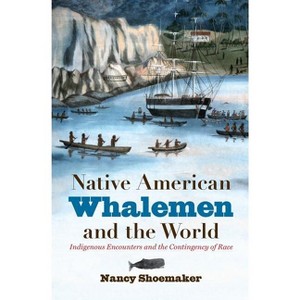
Native American Whalemen and the World - by Nancy Shoemaker (Paperback)
In Stock
Sponsored
About this item
Highlights
- In the nineteenth century, nearly all Native American men living along the southern New England coast made their living traveling the world's oceans on whaleships.
- Author(s): Nancy Shoemaker
- 320 Pages
- History, Native American
Description
Book Synopsis
In the nineteenth century, nearly all Native American men living along the southern New England coast made their living traveling the world's oceans on whaleships. Many were career whalemen, spending twenty years or more at sea. Their labor invigorated economically depressed reservations with vital income and led to complex and surprising connections with other Indigenous peoples, from the islands of the Pacific to the Arctic Ocean. At home, aboard ship, or around the world, Native American seafarers found themselves in a variety of situations, each with distinct racial expectations about who was "Indian" and how "Indians" behaved. Treated by their white neighbors as degraded dependents incapable of taking care of themselves, Native New Englanders nevertheless rose to positions of command at sea. They thereby complicated myths of exploration and expansion that depicted cultural encounters as the meeting of two peoples, whites and Indians.
Highlighting the shifting racial ideologies that shaped the lives of these whalemen, Nancy Shoemaker shows how the category of "Indian" was as fluid as the whalemen were mobile.
Review Quotes
"A monumental, erudite study of a fleeting industry that was buttressed by a racial and ethnic mosaic. . . . A well-told tale of prejudice, perseverance, and pride of accomplishment. . . . A welcome addition to the literature of whaling and maritime history." -- Northern Mariner/Le marin du nord
"A rich, detailed, and nuanced portrait of Native American whalemen." -- International Journal of Maritime History
"An outstanding and wide-ranging work that should offer a lot to geographers interested in how cultural encounters and the contingencies of race played out in one of the world's first truly globalized and mobile industries." -- Journal of Historical Geography
"Challenging earlier studies that focus almost entirely on the exploitative aspects of whaling or on the stereotypical images of Indian harpoonists, the author shows that Native Americans served at every level of the industry, including as captains of ships." -- CHOICE
"Immeasurably improve[s] our knowledge of Native American whalers, their lives, and their work. No doubt [this book] will become [a] historical classic." -- Journal of Pacific History
"Inspire[s] examinations into the lived experience and historical memory of Native Americans . . . fluidly written." -- - American Historical Review
"Meticulously researched and skillfully structured." -- Journal of American History
"Shoemaker is a social historian extraordinaire. . . . This is an impressive book that places Native Americans in the midst of global history and sheds new light on the shifting boundaries of race and indigeneity in the nineteenth century. It makes an important contribution to the scholarship of race, indigenous peoples, labor, and maritime history." -- Western Historical Quarterly
"This fascinating study of Native American whalemen is an impressive achievement: a careful, deeply informed, and insightful analysis of the complexities and variable nature of identity. Shoemaker successfully recovers the lives of some of the most elusive historical subjects, working-class men from marginalized communities, whose names, residences, nationalities, and ethnicities all varied dramatically from place to place and over the course of their lives. Identifying and locating these shape-shiftings is at the center of Shoemaker's persuasive argument about the contingency of race." -- Lisa Norling, author of Captain Ahab Had a Wife: New England Women and the Whalefishery, 1720-1870
"This outstanding book . . . exemplifies the best of new oceanic history." -- New England Quarterly
Shipping details
Return details
Frequently bought together





Guests also viewed





Discover more options