Target New ArrivalsGift Ideas for MomClothing, Shoes & AccessoriesHome & DecorKitchen & DiningOutdoor Living & GardenGroceryHousehold EssentialsBabyBeautyPersonal CareHealthWellnessLuggageSports & OutdoorsToysElectronicsVideo GamesMovies, Music & BooksSchool & Office SuppliesParty SuppliesGift IdeasGift CardsPetsUlta Beauty at TargetShop by CommunityTarget OpticalDealsClearanceTarget New ArrivalsSpring OutfitsGift Ideas for MomWomen’s Festival OutfitsTop DealsTarget Circle DealsWeekly AdShop Order PickupShop Same Day DeliveryRegistryRedCardTarget CircleFind Stores
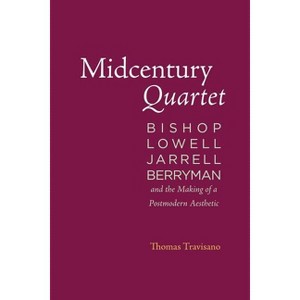
Midcentury Quartet - by  Thomas Travisano (Paperback) - 1 of 1

Midcentury Quartet - by Thomas Travisano (Paperback)

$40.50

In Stock

Free & easy returns

Free & easy returns

Return this item by mail or in store within 90 days for a full refund.
Eligible for registries and wish lists

About this item

Highlights

  • In a February 1966 letter to her artistic confidant, Robert Lowell, Elizabeth Bishop tellingly grouped four midcentury poets: Lowell, Randall Jarrell, John Berryman, and herself.
  • About the Author: Thomas Travisano is Cora A. Babcock Professor of English at Hartwick College in Oneonta, New York.
  • 344 Pages
  • Literary Collections, General

Description


About the Book


By arguing so sharply for the importance of this circle, Midcentury Quartet is certain to redraw the map of postwar American poetry.


Book Synopsis


In a February 1966 letter to her artistic confidant, Robert Lowell, Elizabeth Bishop tellingly grouped four midcentury poets: Lowell, Randall Jarrell, John Berryman, and herself. For Bishop--always wary of being pigeonholed and therefore reticent about naming her favorite contemporaries--it was a rare explicit acknowledgment of an informal but enduring artistic circle that has evaded the notice of literary journalists for more than forty years. Despite the private nature of their dialogue, the group's members--Bishop, Lowell, Jarrell, and Berryman--left a compelling record of their mutual interchange and influence. Drawing on an extensive range of published and archival sources, Thomas Travisano traces these poets' creation of a surprisingly coherent postmodern aesthetic and defines its continuing influence on American poetry.

The refusal of this "midcentury quartet," as Travisano calls them, to voice a formalized doctrine, coupled with their intuitive way of working, has caused critics to miss the coherence of their project. Travisano argues that these poets are not only successors to Pound, Auden, Stevens, and Eliot but postmodern explorers in their own right. In forging their own aesthetic, characterized here as a postmodern mode of elegy, they encountered significant resistance from their immediate modernist mentors Allen Tate, John Crowe Ransom, and Marianne Moore.

Jarrell, whom others of the group regarded as a critic of particular genius, was first described as a post-modernist in a 1941 review by Ransom that Travisano cites as the earliest known use of the term. In Jarrell's review of Lowell's Lord Weary's Castle six years later, he named Lowell a postmodernist and identified traits, among them the use of pastiche, that are now considered by theorists such as Fredric Jameson as specifically postmodern. And Bishop's inventiveness allowed her to adapt a self-exploratory mode often, but imprecisely, termed confessional to challenging forms such as the double sonnet, villanelle, and sestina.

Each of these poets suffered a devastating loss during childhood and lived through the twentieth-century disasters of the Great Depression, World War II and the Holocaust, and the cold war. The continual tension in their poetry between subjectivity and form, claims Travisano, reflects the plight of the fractured individual in a postmodern world. By arguing so sharply for the importance of this circle, Midcentury Quartet is certain to redraw the map of postwar American poetry.


Review Quotes


One of the best books on post-World War II American poetry ever written. Travisano has found major poems and revealing letters and essays that are unpublished elsewhere.

--Steven Gould Axelrod, University of California, Riverside


About the Author


Thomas Travisano is Cora A. Babcock Professor of English at Hartwick College in Oneonta, New York. He is author of Elizabeth Bishop: Her Artistic Development (Virginia, 1988) and co-editor of Gendered Modernisms: American Women Poets and Their Readers.

Dimensions (Overall): 9.21 Inches (H) x 6.14 Inches (W) x .77 Inches (D)
Weight: 1.16 Pounds
Suggested Age: 22 Years and Up
Number of Pages: 344
Genre: Literary Collections
Sub-Genre: General
Publisher: University of Virginia Press
Format: Paperback
Author: Thomas Travisano
Language: English
Street Date: August 29, 2015
TCIN: 1011232238
UPC: 9780813928340
Item Number (DPCI): 247-08-4081
Origin: Made in the USA or Imported
If the item details aren’t accurate or complete, we want to know about it.

Shipping details

Estimated ship dimensions: 0.77 inches length x 6.14 inches width x 9.21 inches height
Estimated ship weight: 1.16 pounds
We regret that this item cannot be shipped to PO Boxes.
This item cannot be shipped to the following locations: American Samoa (see also separate entry under AS), Guam (see also separate entry under GU), Northern Mariana Islands, Puerto Rico (see also separate entry under PR), United States Minor Outlying Islands, Virgin Islands, U.S., APO/FPO, Alaska, Hawaii

Return details

This item can be returned to any Target store or Target.com.
This item must be returned within 90 days of the date it was purchased in store, delivered to the guest, delivered by a Shipt shopper, or picked up by the guest.
See the return policy for complete information.

Additional product information and recommendations

Discover more options

Trending Literary Fiction

Get top deals, latest trends, and more.

Privacy policy