Sponsored
In Stock
Sponsored
About this item
Highlights
- Medical science in antebellum America was organized around a paradox: it presumed African Americans to be less than human yet still human enough to be viable as experimental subjects, as cadavers, and for use in the training of medical students.
- About the Author: Christopher D.E Willoughby is visiting professor of the history of medicine and health at Pitzer College.
- 282 Pages
- Social Science, Ethnic Studies
Description
About the Book
"Medical science in antebellum America was organized around a paradox: it presumed African Americans to be less than human yet still human enough to be viable as experimental subjects, as cadavers, and for use in the training of medical students. By taking a hard look at the racial ideas of both northern and southern medical schools, Christopher D.E. Willoughby reveals that racist ideas were not external to the medical profession but fundamental to medical knowledge"--
Book Synopsis
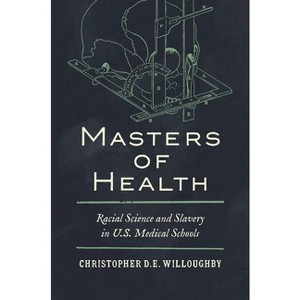
Medical science in antebellum America was organized around a paradox: it presumed African Americans to be less than human yet still human enough to be viable as experimental subjects, as cadavers, and for use in the training of medical students. By taking a hard look at the racial ideas of both northern and southern medical schools, Christopher D. E. Willoughby reveals that racist ideas were not external to the medical profession but fundamental to medical knowledge.
In this history of racial thinking and slavery in American medical schools, the founders and early faculty of these schools emerge as singularly influential proponents of white supremacist racial science. They pushed an understanding of race influenced by the theory of polygenesis--that each race was created separately and as different species--which they supported by training students to collect and measure human skulls from around the world. Medical students came to see themselves as masters of Black people's bodies through stealing Black people's corpses, experimenting on enslaved people, and practicing distinctive therapeutics on Black patients. In documenting these practices Masters of Health charts the rise of racist theories in U.S. medical schools, throwing new light on the extensive legacies of slavery in modern medicine.
Review Quotes
"...Highly thought-provoking and timely in understanding the history of U.S...The book makes a compelling connection between our experiences today and 19th-century medical training in the United States."--LAMPHHS's The Watermark
"A compelling exploration of how ideas about race were constructed by American medical professionals in the nineteenth century and then used to increase their recognition as experts. . . [A] valuable addition to the historiography."--Journal of American History
"An important book, building on an emerging body of work focused on exploring the centrality of medicine to the construction of ideas about race in the nineteenth-century United States, the perpetuation of race-based slavery, and the expansion of capitalism throughout the nation. Willoughby's compelling study makes a valuable contribution to these historiographical fields, drawing much-needed attention to the complicity of northern medical schools in shaping ideas about race in an antebellum America and on shores beyond."--Journal of Southern History
"An original, fascinating, and convincing book that takes us far beyond the standard narrative of race and medicine in America. Through deep immersion into archival sources, Masters of Health significantly reshapes our understanding of the role of antebellum U.S. medical education in producing white supremacy."--Sharla M. Fett, author of Recaptured Africans: Surviving Slave Ships, Detention, and Dislocation in the Final Years of the Slave Trade
"Crucial reading for historians as well as physicians, this book shifts historical attention away from the South and slavery to explore how the so-called benevolent and free North was equally culpable in the exploitation of black bodies. Highlighting the importance of imperial expansion and transnational cultural infusions to the evolution of American medicine, Willoughby intricately illustrates the wider Atlantic origins of professional medicine in America."--Sasha D. Turner, author of Contested Bodies: Pregnancy, Childrearing, and Slavery in Jamaica
"This book is a meticulous autopsy of a ghoulish intellectual scandal. In this disturbing history of medical schools in the United States, we learn how debates over slavery, nature, and the origin of humankind played out on suffering bodies and desecrated corpses and imbued racist thought into the management of medicine. Willoughby is a talented storyteller with the moral gravity of an Old Testament orator. At stake here may be nothing less than the scholarly salvation of American health care."--Vincent Brown, author of The Reaper's Garden: Death and Power in the World of Atlantic Slavery
"Willoughby powerfully demonstrates that medicalized race thinking was not limited to the South. . . . [H]e artfully untangles the vast web of social and professional connections within the medical community that allowed racial essentialism to garner adherents, and long after emancipation. . . . [E]ssential reading not just for historians and doctors but for anyone seeking to grapple with the painful history of medicalized racism."--Journal of African American History
"Willoughby provides us with a helpful set of analytics through which to understand how American medical racism and scientific racism grew up together, functioning as a transfer of Southern slavery ideology to the North, reinforcing the institution of slavery in the South, and spurring the evolution of polygenetic conceptions of race as a biological truth."--Technology and Culture
"Willoughby's debut monograph makes an important contribution both to histories of medical education and to the historicization of current racialized disparities in healthcare. . . . [A] thorough and expansive piece of scholarship, adding much to our understanding of the history of race and medicine in the US context. . . . [T]his work forms a key foundation on which assessments of how these theories of racial difference and hierarchy have embedded themselves within the modern medical curriculum, and medical research practices can build."--British Journal for the History of Science
"With innovative archival research on the writings of medical students, Willoughby brilliantly illuminates how ideas about Black anatomical difference found an intellectual home in medical schools, becoming foundational to U.S. medical culture, pedagogy, and practice and to the politics of slavery, global capitalism, and imperialism. Willoughby provides a crucial lesson for grappling with racism in medicine today: we must trace its persistence not so much to the racist doctors who built the medical profession but more to the way racist ideas grounded the medical profession's development. Masters of Health is essential reading for understanding medicine's enduring entanglements with slavery and for efforts to eliminate their afterlives in medicine today."--Dorothy Roberts, author of Fatal Invention: How Science, Politics, and Big Business Re-create Race in the Twenty-First Century
About the Author
Christopher D.E Willoughby is visiting professor of the history of medicine and health at Pitzer College. He is also editor of the book Medicine and Healing in the Age of Slavery.
Shipping details
Return details
Frequently bought together

Discover more options