Sponsored
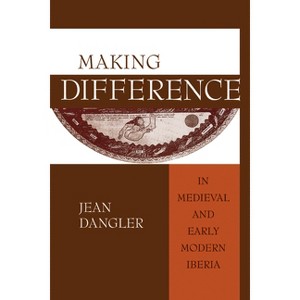
Making Difference in Medieval and Early Modern Iberia - Annotated by Jean Dangler Paperback
In Stock
Sponsored
About this item
Highlights
- In this engaging study Jean Dangler examines the way that ideas of difference were forged in four types of medieval Iberian discourse: muwashshah/jarcha poems from al-Andalus, Andalusi "cutting poems," medical literature about the body, and portrayals of the monster.
- About the Author: Jean Dangler is a professor in the Department of Spanish and Portuguese at Tulane University
- 230 Pages
- Literary Criticism, Medieval
Description
About the Book
A perspective on a medieval Iberia that sustained a fluid concept of identity and an acceptance of difference that extended even to the level of the deformed monstrous
Book Synopsis
In this engaging study Jean Dangler examines the way that ideas of difference were forged in four types of medieval Iberian discourse: muwashshah/jarcha poems from al-Andalus, Andalusi "cutting poems," medical literature about the body, and portrayals of the monster. According to Dangler, these texts demonstrate the two fundamental precepts of medieval Iberian alterity: multifaceted subject formation and the embrace of contrasts and the negative.
Medieval Iberia was a multicultural territory of Muslim, Jewish, and Christian societies. These communities had constant geographic, cultural, political, and economic contact with one another. Because medieval Iberia was not hierarchical and homogenous, medieval subjectivity was not always marked by essential qualities of character, but was mutable and shifting. The adverse was often esteemed in the making of meaning and the forging of the social order. Dangler explores how the four discourses she analyzes changed in the early modern period, from an acceptance of difference to more rigid concepts of subjectivity and the marginalization of difference. This shift accompanied the rise of the Castilian nation-state and its imposition of static hierarchies of value.
This book will appeal to a broad range of medievalists. It makes an important contribution to the growing interest in medieval Iberia and offers a nuanced understanding of medieval history and culture in general.
Review Quotes
"Jean Dangler's book explores new ways to explain the problem of alterity in the medieval and early modern Iberian peninsula. By challenging our preconceived ideas, Dangler gives us a new set of important questions that will lead us to perceive in a different form this essential period: How can we understand alterity in multicultural societies? How can we deal with difference as a cultural category? And, when the construction of difference and alterity changes, how are these changes debated in the 'body' of culture? Her study is not only an extremely original piece of scholarship; it is also a way that can lead scholars to establish a dialogue that is, more than ever, a necessity." --Jesús D. Rodríguez-Velasco, University of California, Berkeley
"This is a book of great importance. Dangler's judicious and complex arguments are exemplary and in many ways the best ever written in this fraught area." --Maria Rosa Menocal, Yale University
"Using an interesting and diverse assortment of texts--from the canonical to little studied 'cutting poems, ' riddles, and medical texts--Dangler provides a fresh perspective on a medieval Iberia that sustained a fluid concept of identity and an acceptance of difference that extended even to the level of the deformed monstrous. Her insights enrich our understanding of the texts and of medieval culture." --Margaret R. Greer, Duke University
". . . this is an intriguing and enticing study of medieval and early modern Iberia, one that suggests to all Western European historians that there is more below the Pyrenees that needs to be uncovered and studied." --The Historian
"Dangler looks at the forces that define and control alterity in four sets of discourses: muwashsha/jarcha poetry of al-Andalus, lace-like Andalusi 'cutting poems' (cartas de Tijeras), medical treatises concerning the body, and representations of monsters. Relating the development of the medieval models to changing perceptions of the Otherness and to the cultural values that both inform and derive from them, the author argues that medieval society did not depend on the hierarchies and acts of denigration that came to characterize the early modern mindset. . . Highly recommended." --Choice
"Jean Dangler. . . examines ways in which ideas of difference were forged in four types of Iberian discourse: jarchas poems from Al-Andalus, Andalusí cutting poems, medical literature about the body, and discourses about monsters. . . Her enthralling analysis of these four discourses examines early modern transformations that illustrate shifts in the perceptions of alterity and in prevailing cultural values." --This Year's Work in Modern Language Studies
About the Author
Jean Dangler is a professor in the Department of Spanish and Portuguese at Tulane University
Shipping details
Return details
Discover more options