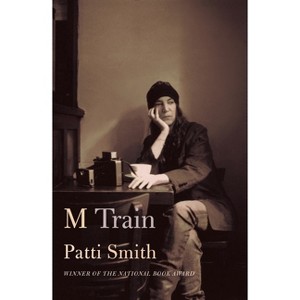
M Train - by Patti Smith (Hardcover)
In Stock
About this item
Highlights
- National Best Seller From the National Book Award-winning author of Just Kids an unforgettable odyssey of a legendary artist, told through the prism of the cafés and haunts she has worked in around the world.
- ALA Notable Books (Nonfiction) 2016 1st Winner, Michigan Notable Books 2016 1st Winner
- About the Author: PATTI SMITH is a writer, performer, and visual artist.
- 272 Pages
- Biography + Autobiography, Personal Memoirs
Description
Book Synopsis
National Best Seller
From the National Book Award-winning author of Just Kids an unforgettable odyssey of a legendary artist, told through the prism of the cafés and haunts she has worked in around the world. It is a book Patti Smith has described as "a roadmap to my life."
M Train begins in the tiny Greenwich Village café where Smith goes every morning for black coffee, ruminates on the world as it is and the world as it was, and writes in her notebook. Through prose that shifts fluidly between dreams and reality, past and present, and across a landscape of creative aspirations and inspirations, we travel to Frida Kahlo's Casa Azul in Mexico; to a meeting of an Arctic explorer's society in Berlin; to a ramshackle seaside bungalow in New York's Far Rockaway that Smith acquires just before Hurricane Sandy hits; and to the graves of Genet, Plath, Rimbaud, and Mishima.
Woven throughout are reflections on the writer's craft and on artistic creation. Here, too, are singular memories of Smith's life in Michigan and the irremediable loss of her husband, Fred Sonic Smith.
Braiding despair with hope and consolation, illustrated with her signature Polaroids, M Train is a meditation on travel, detective shows, literature, and coffee. It is a powerful, deeply moving book by one of the most remarkable multiplatform artists at work today.
Review Quotes
"Incantatory . . . Unlike her first memoir, the now classic, Just Kids, which was all about the thrill of 'becoming, ' M Train is mostly about the challenge of enduring erosion and discovering new passions (like detective fiction and a tumbledown cottage in Rockaway Beach, Queens). Smith, of course, is a 'kid' no longer. She's suffered a lot of losses, including the deaths of artist Robert Mapplethorpe, who was her partner in crime in the Just Kids years, and her husband, musician Fred 'Sonic' Smith, who died suddenly in his 40s. 'They are all stories now, ' says Smith, thinking of these and other deaths . . . Both of Smith's memoirs tell a haunting story about being sheltered and fed, in all senses, by New York City." --Maureen Corrigan, NPR (Best Books of 2015)
"Patti Smith's new book remains one of the best reading experiences I had this year . . . elliptical and fragmentary, weird and beautiful, and, at its core, a reckoning with loss. Much has been made of the book's seeming spontaneity, its diaristic drift. But as the echoes among its discrete episodes pile up, it starts to resonate like a poem. At one point, Smith writes about W.G. Sebald, and there are affinities with The Emigrants in the way M Train circles around a tragedy, or constellation of tragedies, pointing rather than naming. It is formally a riskier book than the comparatively straight-ahead Just Kids, but a worthy companion piece. And that Smith is still taking on these big artistic dares in 2015 should inspire anyone who longs to make art. In this way, and because it is partly a book about reading other books--how a life is made of volumes--it seems like a fitting way to turn the page on one year in reading, and to welcome in another." --Garth Risk Hallberg, The Millions
"Rich, inventive . . . Where Just Kids charted Smith's path from childhood to celebrity, M Train does not move in a simple arc from one destination to another. It meanders between her interior life and her life in the world, connecting dreams, reflections and memories. Smith's language lures the reader down this nonformulaic path. She doesn't slap a convenient label on emotions; she dissects them. With each sip [of coffee], her ruminations deepen . . . M Train is less about achieving success than surviving it. Smith has outlived many of the companions who sustained her in her youth. She grieves for her husband and her brother; she mourns the artists with whom she had felt a connection when they were alive, including Burroughs and Bowles. And in a scene that strikes a universal chord, she mourns her mother . . . At the center of M Train is the passage of time--the way places and events can mean different things at different stages in a person's life . . . Tender, heartbreaking." --M. G. Lord, The New York Times Book Review
"Incandescent . . . moving, lovely. Patti Smith is a poet with a mindful of memories enough to fill M Train to the brim. Let's be clear: every observation is beautiful. M Train is chiefly concerned with salvaging the pieces that, together, form a life entire . . . In its barest sense, the book is a series of cups of coffee around the world, drunk between waking and sleep. But once the memoir has sunk in its claws, these rituals become a framework for more meaningful observations. What is a life, if not a pattern interrupted by occasional revelations or surprises? Where Just Kids traced the linear progression of her friendship with photographer Robert Mapplethorpe and her coming of age in 1970s New York City, M Train finds its footing in shared experiences. It's the universal--not rock 'n' roll in particular--that haunts the reader most . . . Aging and loss transcend fame and geography. Smith whittles her prose down to the essentials . . . M Train's greatest reward, for a reader, is her unwillingness to bend to the dream-cowboy's recurring doubts [about] 'writing about nothing.' Even nothing has meaning--the found objects, the things remembered, the cups of coffee that mark our days better than clocks. Would that every tribute to a life lived sang so beautifully." --Linnie Greene, The Rumpus
"It's easy to see why so many readers say that M Train changed [their] lives. It's every bit the book Just Kids is, full of the same lovely writing, resolute faith in the consolations of art, odd flashes of humor, rawness to memory and experience. It's obvious why readers find a deep, deep correspondence to their own inner lives in her work . . . The deeper memories in M Train tacitly trace the origins of a new phase of [Smith's] life, including the loss of her parents and, most crucially, of her husband. She conveys with tender restraint what it has meant to lose him, how linked their spirits were. Moments [of] remarkable power blend directness, melancholy, and memory. Smith's searching voice speaks for a generation that has realized later than most that it, too, would age. 'I want to hear my mother's voice, ' she writes. 'I want to see my children as children.' But only the artist is innocent enough, or brave enough, to try and live a second time." --Charles Finch, Chicago Tribune
"Intimate and elegantly crafted . . . As a child, a woman and an acclaimed artist, Smith has long reflected on the power of invention and how it shapes a life. Her writing moves effortlessly between past and present, both Smith's and that of the scholars and makers who have inspired her and with whom she feels a kinship--the Japanese auteur Akira Kurosawa, the poet Rimbaud, or Alfred Wegener, the first scientist to present the idea of continental drift. As Smith slips in and out of reverie, the effect is one of a motionless travel; throughout her journeys, real and imagined, she considers what it means to endure the hardships fed to us by time . . . For Smith, this means following her wild and associative mind, a sort of thinking that seams the unremarkable with the sublime. At the heart of M Train is the careful braid the author makes between everyday matters and her lyrical take on how art offers a form of sustenance . . . To Smith, the constellation of human experience is as valued in Jane Eyre as it is in Law & Order--at times, we are dreaming about the high plains even as we clean up after the cats, and try to figure out where we left our wallet. Her photographs appear throughout the book like ghosts, dim and unadorned, a way of seeing how Smith's imagination elevates the humble objects she cherishes. A silver thread also works its way through her stories--her memories of her late husband, the guitarist Fred Sonic Smith, whose wisdom she grieves for and celebrates. The book's final essays are a testimony to his words because they dwell deeply on how the mind's fires can light a way toward hope." --Emma Trelles, Miami Herald
"What makes riding the M Train so rewarding is the way solemn, eloquent meditations on Genet and Kahlo, William Burroughs and Sylvia Plath are offset by Patti Smith moments--like an imaginary dialogue with Nikola Tesla, 'the patron saint of alternating currents.'"--Stuart Mitchner, Princeton Town Topics
"M Train comes near to accomplishing Marcel Proust's goal to follow the workings of the human mind and the human heart. By the end of the book you know that nothing is everything, and that life is a labor of love." --Joan Juliet Buck, Harper's Bazaar
"Intimate, delicately revealing . . . M Train concentrates on a recent spell in Smith's life, one where she spent days at a local café drinking coffee, writing, and reflecting. Most of M Train revolves around the pleasure of a local café--a public place to be private--and that sentiment is at the heart of this book . . . Occasionally, Smith dips back into her relationship with Fred 'Sonic' Smith, remembering the moments when the pair took advantage of everything Michigan had to offer, from dive bars in Detroit to beaches on the upper edge of the lower peninsula . . . Perhaps the biggest surprise of M Train is Smith's deep, personal connection with detective shows." --Stephen Thomas Erlewine, Vulture.com
"Evocative . . . M Train, works [like] 'an interior hopscotch in the mind, recording time backwards and forwards' as Smith skips from moment to moment across the past forty years of her life. Reading the book feels rather like navigating a lucid dream . . . Smith's words are rhythmic, arranged according to 'the music of [her] imagination' . . . The playful tone is endearing, and buoys what is, above all, a meditation on loss--of people, yes, but also of the objects to which she has become attached . . . Time shifts in M Train One moment Smith is in a café, the next she is staring at [her husband] Fred as he crouches over a cornucopia of her most loved lost things . . . Patti Smith loves nothing lightly, and if she makes writing about [nothing] look easy, consider that it's not actually nothing she's writing about--it's everything." --Claire Lampen, Hyperallergic.com
"Satisfying . . . Cup after cup of coffee in cafes from Greenwich Village to Tangiers is downed by the Godmother of Punk as this book unfolds . . .There are many pleasures to be found here. This is a book of quiet meditation wherein a CSI: Miami marathon can inspire the same deep self-reflection as the work of the late Chilean author Roberto Bolano. Smith stares into her black coffee and whole worlds are opened up to her. M Train is her report back from those journeys." --Kristofer Collins, Pittsburgh Post-Gazette
"What does it mean to be a woman alone? This question lies at the heart of M Train. That, and the eternal query, Where's the best place to get a good coffee? A caffeine-fueled travelogue of first-person vignettes, M Train conjures ghosts. The book's touchstones are either cultural heroes (Jean Genet, Alfred Wegener, Akira Kurosawa) whose graves she tracks down in search of talismans, or they're lost loved ones, specifically [her husband] Fred and her brother Todd, both of whom died in 1994. Smith's muses are memories, or figures in dreams, or names in books . . . M Train begins and ends in a dream state. The line between waking and sleeping, remembering and doing, living and dying, is porous for Smith . . . Discursive, fanciful, geeky, transgressive, just plain and delightfully weird, it's a book that loses you and you get lost in, finding your own kernels of truth and resonance." --Evelyn McDonnell, Los Angeles Review of Books
**** "Powerful . . . Smith shares a rush of memories, reveries, and revelations that reach a height with all the expressive power of her most rapturous '70s rock. M Train is a great meditation on solitude, independence, age, a ride-along with the last Romantic standing . . . It proceeds through cups of coffee at tables for one, on planes and in hotels across Latin America, Europe and Asia, animated by a mellowing grief for Smith's husband, who died in 1994. Yet Smith doesn't mourn so much as celebrate their love . . . Smith inventories her inspirations, and makes her house out of the life lived, out of the love spent. M Train will make this year's best-of lists." --Matt Damsker, USA Today (four stars)
About the Author
PATTI SMITH is a writer, performer, and visual artist. She gained recognition in the 1970s for her revolutionary merging of poetry and rock. She has released twelve albums, including Horses, which has been hailed as one of the top one hundred albums of all time by Rolling Stone.
Smith had her first exhibit of drawings at the Gotham Book Mart in 1973 and has been represented by the Robert Miller Gallery since 1978. Her books include Just Kids, winner of the National Book Award in 2010, Wītt, Babel, Woolgathering, The Coral Sea, and Auguries of Innocence.
In 2005, the French Ministry of Culture awarded Smith the title of Commandeur des Arts et des Lettres, the highest honor given to an artist by the French Republic. She was inducted into the Rock and Roll Hall of Fame in 2007.
Smith married the musician Fred Sonic Smith in Detroit in 1980. They had a son, Jackson, and a daughter, Jesse. Smith resides in New York City.
Shipping details
Return details
Additional product information and recommendations
Related Categories
Discover more options





Trending Biography & Autobiography