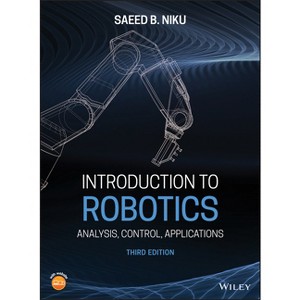
Introduction to Robotics: Analysis, Control, Applications, 3rd Edition The revised text to the analysis, control, and applications of robotics The revised and updated third edition of Introduction to Robotics: Analysis, Control, Applications, offers a guide to the fundamentals of robotics, robot components and subsystems and applications.
About the Author: SAEED BENJAMIN NIKU, PhD, P.E., is a Professor of Mechanical Engineering at California Polytechnic State University, San Luis Obispo, California.
528 Pages
Technology, Robotics
Description
About the Book
"This new 3rd edition of the Introduction to Robotics textbook is the culmination of over a year of intense work. If judging the previous edition by the number of instructors who adopted it, number of countries in which it was popularly sold, and the number of language into which it was translated indicates that it was a good book, I hope that this new edition is even better. It has two completely new chapters on screw-based mechanics and on parallel robots, it has many new examples and homework problems, it has many new subjects in most chapters, and the writing has been edited and streamlined throughout"--
Book Synopsis
Introduction to Robotics: Analysis, Control, Applications, 3rd Edition
The revised text to the analysis, control, and applications of robotics
The revised and updated third edition of Introduction to Robotics: Analysis, Control, Applications, offers a guide to the fundamentals of robotics, robot components and subsystems and applications. The author--a noted expert on the topic--covers the mechanics and kinematics of serial and parallel robots, both with the Denavit-Hartenberg approach as well as screw-based mechanics. In addition, the text contains information on microprocessor applications, control systems, vision systems, sensors, and actuators.
Introduction to Robotics gives engineering students and practicing engineers the information needed to design a robot, to integrate a robot in appropriate applications, or to analyze a robot. The updated third edition contains many new subjects and the content has been streamlined throughout the text. The new edition includes two completely new chapters on screw-based mechanics and parallel robots. The book is filled with many new illustrative examples and includes homework problems designed to enhance learning. This important text:
Offers a revised and updated guide to the fundamental of robotics
Contains information on robot components, robot characteristics, robot languages, and robotic applications
Covers the kinematics of serial robots with Denavit-Hartenberg methodology and screw-based mechanics
Includes the fundamentals of control engineering, including analysis and design tools
Discusses kinematics of parallel robots
Written for students of engineering as well as practicing engineers, Introduction to Robotics, Third Edition reviews the basics of robotics, robot components and subsystems, applications, and has been revised to include the most recent developments in the field.
From the Back Cover
The revised text to the analysis, control, and applications of robotics
The revised and updated third edition of Introduction to Robotics: Analysis, Control, Applications offers a guide to the fundamentals of robotics, robot components and subsystems and applications. The author--a noted expert on the topic--covers the mechanics and kinematics of serial and parallel robots, both with the Denavit-Hartenberg approach as well as screw-based mechanics. In addition, the text contains information on microprocessor applications, control systems, vision systems, sensors, and actuators.
Introduction to Robotics gives engineering students and practicing engineers the information needed to design a robot, to integrate a robot in appropriate applications, or to analyze a robot. The updated third edition contains many new subjects and the content has been streamlined throughout the text. The new edition includes two completely new chapters on screw-based mechanics and parallel robots. The book is filled with many new illustrative examples and includes homework problems designed to enhance learning. This important text:
Offers a revised and updated guide to the fundamentals of robotics
Contains information on robot components, robot characteristics, robot languages, and robotic applications
Covers the kinematics of serial robots with Denavit-Hartenberg methodology and screw-based mechanics
Includes the fundamentals of control engineering, including analysis and design tools
Discusses kinematics of parallel robots
Written for students of engineering as well as practicing engineers, Introduction to Robotics, Third Edition reviews the basics of robotics, robot components and subsystems, applications, and has been revised to include the most recent developments in the field.
About the Author
SAEED BENJAMIN NIKU, PhD, P.E., is a Professor of Mechanical Engineering at California Polytechnic State University, San Luis Obispo, California. He has taught courses in mechanics, robotics, design, and creativity.
Dimensions (Overall): 11.0 Inches (H) x 8.7 Inches (W) x 1.3 Inches (D)
Weight: 3.4 Pounds
Suggested Age: 22 Years and Up
Number of Pages: 528
Genre: Technology
Sub-Genre: Robotics
Publisher: Wiley
Format: Hardcover
Author: Saeed B Niku
Language: English
Street Date: February 10, 2020
TCIN: 1008782931
UPC: 9781119527626
Item Number (DPCI): 247-25-1183
Origin: Made in the USA or Imported
If the item details aren’t accurate or complete, we want to know about it.
Shipping details
Estimated ship dimensions: 1.3 inches length x 8.7 inches width x 11 inches height
Estimated ship weight: 3.4 pounds
We regret that this item cannot be shipped to PO Boxes.
This item cannot be shipped to the following locations: American Samoa (see also separate entry under AS), Guam (see also separate entry under GU), Northern Mariana Islands, Puerto Rico (see also separate entry under PR), United States Minor Outlying Islands, Virgin Islands, U.S., APO/FPO
Return details
This item can be returned to any Target store or Target.com.
This item must be returned within 90 days of the date it was purchased in store, shipped, delivered by a Shipt shopper, or made ready for pickup.