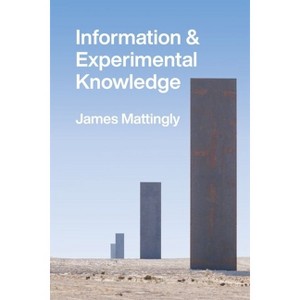
An ambitious new model of experimentation that will reorient our understanding of the key features of experimental practice.
About the Author: James Mattingly is associate professor in the Department of Philosophy at Georgetown University.
400 Pages
Philosophy, Epistemology
Description
About the Book
"What is experimental knowledge, and how do we get it? There is general agreement that experiment is a crucial source of scientific knowledge, much less about how experiment generates that knowledge. In this book, philosopher of science James Mattingly explains how experiments function. Specifically, he discusses what it is about experimental practice that transforms observations of what may be very sharply localized, very particular, very isolated systems into what may be global, general, integrated empirical knowledge. This involves showing how several activities that are sometimes thought merely to go under the name of experiment-natural experiment, analogical experiment, thought experiment, simulated experiment-really should count as generating experimental knowledge. To do this, he constructs a general model of experimentation and shows how these various practices fit into that model. Mattingly's premise is that the purpose of experimentation is the same as the purpose of any other knowledge generating enterprise--to change the state of information of the knower. This trivial-seeming point has a non-trivial consequence: to understand a knowledge generating enterprise, we should follow the flow of information. Therefore, the account of experimental knowledge Mattingly provides is based on understanding how information flows in experiments: what facilitates that flow, what hinders it, what the characteristics of different practices are with respect to how they allow information to flow from system to system, into the heads of researchers, and finally into our store of scientific knowledge"--
Book Synopsis
An ambitious new model of experimentation that will reorient our understanding of the key features of experimental practice.
What is experimental knowledge, and how do we get it? While there is general agreement that experiment is a crucial source of scientific knowledge, how experiment generates that knowledge is far more contentious. In this book, philosopher of science James Mattingly explains how experiments function. Specifically, he discusses what it is about experimental practice that transforms observations of what may be very localized, particular, isolated systems into what may be global, general, integrated empirical knowledge. Mattingly argues that the purpose of experimentation is the same as the purpose of any other knowledge-generating enterprise-to change the state of information of the knower. This trivial-seeming point has a non-trivial consequence: to understand a knowledge-generating enterprise, we should follow the flow of information. Therefore, the account of experimental knowledge Mattingly provides is based on understanding how information flows in experiments: what facilitates that flow, what hinders it, and what characteristics allow it to flow from system to system, into the heads of researchers, and finally into our store of scientific knowledge.
Review Quotes
"A very stimulating and original exploration of a large number of issues linked to the role of experimentation in science. These include, among many others, the connection between experiments and causal inference, the notion of experimental replication, and the relationship between thought experiments and more ordinary experiments. Mattingly defends a novel account of experiments as having to do with the flow of information between proximate systems which are the immediate objects of experimentation and the more distal systems which we use experiments to learn about. I strongly recommend this thought-provoking book to anyone with an interest in these topics."--James Woodward, University of Pittsburgh
About the Author
James Mattingly is associate professor in the Department of Philosophy at Georgetown University.
Dimensions (Overall): 9.0 Inches (H) x 6.0 Inches (W) x .88 Inches (D)
Weight: 1.47 Pounds
Suggested Age: 22 Years and Up
Number of Pages: 400
Genre: Philosophy
Sub-Genre: Epistemology
Publisher: University of Chicago Press
Format: Hardcover
Author: James Mattingly
Language: English
Street Date: December 13, 2021
TCIN: 1008784292
UPC: 9780226804644
Item Number (DPCI): 247-27-4761
Origin: Made in the USA or Imported
If the item details aren’t accurate or complete, we want to know about it.
Shipping details
Estimated ship dimensions: 0.88 inches length x 6 inches width x 9 inches height
Estimated ship weight: 1.47 pounds
We regret that this item cannot be shipped to PO Boxes.
This item cannot be shipped to the following locations: American Samoa (see also separate entry under AS), Guam (see also separate entry under GU), Northern Mariana Islands, Puerto Rico (see also separate entry under PR), United States Minor Outlying Islands, Virgin Islands, U.S., APO/FPO
Return details
This item can be returned to any Target store or Target.com.
This item must be returned within 90 days of the date it was purchased in store, shipped, delivered by a Shipt shopper, or made ready for pickup.