Sponsored
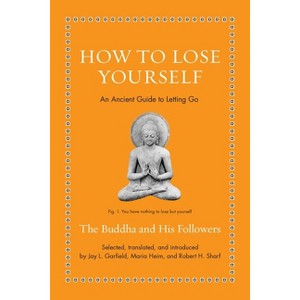
How to Lose Yourself - Ancient Wisdom for Modern Readers by The Buddha Hardcover
In Stock
Sponsored
About this item
Highlights
- Inviting new translations of classical Buddhist texts about why the self is an illusion--and why giving it up can free us from suffering From self-realization and self-promotion to self-help and the selfie, the modern world encourages us to be self-obsessed.
- About the Author: Jay L. Garfield is the Doris Silbert Professor of Philosophy and Buddhist Studies at Smith College and a visiting professor of Buddhist philosophy at Harvard Divinity School.
- 216 Pages
- Philosophy, History & Surveys
- Series Name: Ancient Wisdom for Modern Readers
Description
About the Book
"A central tenet of Buddhism is the idea that the self is an illusion and by relinquishing it, our self-centered impulses melt away. But what does it mean not to have a self, and how does one go about ridding oneself of the idea? Drawing from early Buddhist texts and scriptures from the Theravada, Tibetan Indian, and Chinese Zen traditions, this will be the first non-Greco-Roman volume in our Ancient Wisdom for Modern Readers (AWMR) series. Jay Garfield, Maria Heim, and Robert Sharf introduce and translate the key texts they individually know best. They show how these texts argue that while we exist as conventionally constituted, interdependent persons, we have no self, or core that makes us who we are. More importantly, they reveal that this approach is not nihilistic, but rather, a positive way of thinking about personal identity, ethics, and our place in the world"--Provided by publisher.
Book Synopsis
Inviting new translations of classical Buddhist texts about why the self is an illusion--and why giving it up can free us from suffering
From self-realization and self-promotion to self-help and the selfie, the modern world encourages us to be self-obsessed. We are even told that finding ourselves is the key to happiness. Better to lose yourself! More than 2,500 years ago, the Buddha argued that the self is an illusion--and that our belief in it is the cause of most, if not all, of our suffering. How to Lose Yourself presents lively, accessible, and expert new translations of ancient Buddhist writings about the central, unique, and powerful Buddhist teaching of "no-self."
Drawn from three important Buddhist traditions, these essential Indian, Tibetan, and Chinese writings provide a rich sampling of the ways Buddhist philosophers have understood the idea that we are selfless persons--and why this insight is so therapeutic. When we let go of the self, we are awakened to the presence of all things as they truly are, and we let go of the anxiety, fear, greed, and hatred that are the source of all suffering.
Complete with an introduction and headnotes to each selection, and the original texts on facing pages, How to Lose Yourself is a concise guide to a transformative idea.
Review Quotes
"Engaging and significant."---David Lorimer, Paradigm Explorer
About the Author
Jay L. Garfield is the Doris Silbert Professor of Philosophy and Buddhist Studies at Smith College and a visiting professor of Buddhist philosophy at Harvard Divinity School. He is the author of Losing Ourselves: Learning to Live without a Self (Princeton). Maria Heim is the George Lyman Crosby 1896 & Stanley Warfield Crosby Professor in Religion at Amherst College. She is the author of Words for the Heart: A Treasury of Emotions from Classical India (Princeton). Robert H. Sharf is the D. H. Chen Distinguished Professor of Buddhist Studies in the Department of East Asian Languages and Cultures at the University of California, Berkeley, where he chairs the Numata Center for Buddhist Studies. He is the author of Coming to Terms with Chinese Buddhism.
Shipping details
Return details
Frequently bought together