Sponsored
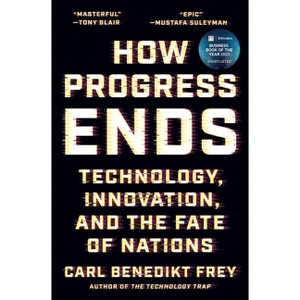
How Progress Ends - by Carl Benedikt Frey (Hardcover)
In Stock
Sponsored
About this item
Highlights
- Shortlisted for the Financial Times and Schroders Business Book of the Year Award How 1,000 years of global history show why technological and economic progress is often followed by stagnation and even collapse In How Progress Ends, Carl Benedikt Frey challenges the conventional belief that economic and technological progress is inevitable.
- About the Author: Carl Benedikt Frey is the Dieter Schwarz Associate Professor of AI and Work at the Oxford Internet Institute and Oxford Martin Citi Fellow at the Oxford Martin School, both at the University of Oxford.
- 552 Pages
- Business + Money Management, Economic History
Description
About the Book
"How 1,000 years of global history show why technological and economic progress is often followed by stagnation and even collapseIn How Progress Ends, Carl Benedikt Frey challenges the conventional belief that economic and technological progress is inevitable. For most of human history, stagnation was the norm, and even today progress and prosperity in the world's largest, most advanced economies-the United States and China-have fallen short of expectations. To appreciate why we cannot depend on any AI-fueled great leap forward, Frey offers a remarkable and fascinating journey across the globe, spanning the past 1,000 years, to explain why some societies flourish and others fail in the wake of rapid technological change.By examining key historical moments-from the rise of the steam engine to the dawn of AI-Frey shows why technological shifts have shaped, and sometimes destabilized, entire civilizations. He explores why some leading technological powers of the past-such as Song China, the Dutch Republic, and Victorian Britain-ultimately lost their innovative edge, why some modern nations such as Japan had periods of rapid growth followed by stagnation, and why planned economies like the Soviet Union collapsed after brief surges of progress. Frey uncovers a recurring tension in history: while decentralization fosters the exploration of new technologies, bureaucracy is crucial for scaling them. When institutions fail to adapt to technological change, stagnation inevitably follows. Only by carefully balancing decentralization and bureaucracy can nations innovate and grow over the long term-findings that have worrying implications for the United States, Europe, China, and other economies today.Through a rich narrative that weaves together history, economics, and technology, How Progress Ends reveals that managing the future requires us to draw the right lessons from the past"-- Provided by publisher.
Book Synopsis
Shortlisted for the Financial Times and Schroders Business Book of the Year Award
How 1,000 years of global history show why technological and economic progress is often followed by stagnation and even collapse
In How Progress Ends, Carl Benedikt Frey challenges the conventional belief that economic and technological progress is inevitable. For most of human history, stagnation was the norm, and even today progress and prosperity in the world's largest, most advanced economies--the United States and China--have fallen short of expectations. To appreciate why we cannot depend on any AI-fueled great leap forward, Frey offers a remarkable and fascinating journey across the globe, spanning the past 1,000 years, to explain why some societies flourish and others fail in the wake of rapid technological change.
By examining key historical moments--from the rise of the steam engine to the dawn of AI--Frey shows why technological shifts have shaped, and sometimes destabilized, entire civilizations. He explores why some leading technological powers of the past--such as Song China, the Dutch Republic, and Victorian Britain--ultimately lost their innovative edge, why some modern nations such as Japan had periods of rapid growth followed by stagnation, and why planned economies like the Soviet Union collapsed after brief surges of progress. Frey uncovers a recurring tension in history: while decentralization fosters the exploration of new technologies, bureaucracy is crucial for scaling them. When institutions fail to adapt to technological change, stagnation inevitably follows. Only by carefully balancing decentralization and bureaucracy can nations innovate and grow over the long term--findings that have worrying implications for the United States, Europe, China, and other economies today.
Through a rich narrative that weaves together history, economics, and technology, How Progress Ends reveals that managing the future requires us to draw the right lessons from the past.
Review Quotes
"With a nuanced study of the past thousand years of technological and economic development that has reshaped societies (and what slows innovation down), an economic historian considers the dichotomies between decentralized dynamism, centralized coordination and scaling to nurture technological progress."---Nathalie Atkinson, Globe & Mail
"Longlisted for the Non-Obvious Book Awards"
"One of OODALoop's Top 10 Technology, Security, and Business Books of 2025"
"Progress isn't a straight line. Frey traces a millennium of innovation to show the tension between the decentralization that can spur new technologies and the bureaucracy crucial to scaling them. Countries and institutions -- from Britain to China -- can either stifle change or scale it, getting the balance right matters now."---Tunde Olanrewaju CBE, Bloomberg
"On a giant macroeconomic and historical scale . . . [How Progress Ends] has huge lessons . . . for both the US and China. . . . it's a heavyweight book that gives you a grand historical perspective on the key question of how to guarantee growth and continued technological advance."---Andrew Hill, Five Books
"A Financial Times Best Book of the Year"
"[Frey] is a world-leading expert on the sources and consequences of technological progress. In this important book, he analyses the . . . impact of artificial intelligence and, more broadly, the prospects for future economic growth."---Martin Wolf, Financial Times
"Compelling."---Adrian Wooldridge, Bloomberg
"We are living in a golden age of big books on economic history. I would add Carl Benedikt Frey's, How Progress Ends: Technology, Innovation and the Fate of Nations, to the list of must reads."-- "Adrian Wooldridge"
"In How Progress Ends, Frey investigates the historical relationship between social structure and economic growth. His sweep is wide, stretching from the Western Zhou dynasty . . . to the European Union today. Both free marketeers and die-hard central planners may find that his conclusions challenge their view of the world. . . . [His] historical analysis has more than a little relevance to today."---Marc Levinson, Wall Street Journal
"Progress is fragile. According to Carl Benedikt Frey, it requires a delicate sequence of innovation and efficient application. This explains why the world is now threatened by low growth. Vested interests dampen the US's ability to leverage its decentralised economy for innovation, while greater centralisation in China puts their dynamism at risk. . . . Explaining something as complex as the success of economies through the neat lens of institutional and technological structure is a tall order. Frey does so with rigour."---Phil Bell, LSE Review of Books
"Shortlisted for the Financial Times and Schroders Business Book of the Year Award"
"It is tempting to assume that progress will always continue. How Progress Ends offers a sobering lesson: great leaps forward often grind to a halt when institutions fail to adapt."---Bernard Marr, Forbes
"Compelling. . . . A thoughtful, deeply informed study, How Progress Ends is both a historical journey and a warning. It challenges readers to recognize that progress is not self-sustaining and that the choices we make now will determine whether innovation continues or quietly fades away."---Margaret Linak, Science
"In How Progress Ends, Carl Benedikt Frey offers a detailed and compelling account of how entrepreneurial, institutional and cultural forces have shaped periods of technological advance and stagnation across the world. In doing so, Frey, an economist and economic historian, draws timely lessons for today's policymakers as the race for supremacy in artificial intelligence and green technology continues. . . . The present moment underscores the relevance of Frey's writing. Business dynamism appears to be fading across much of the advanced world. . . . How Progress Ends is, therefore, an essential warning for the new era."---Tej Parikh, Financial Times
"[Frey's] broad yet deep survey of technology ranges across many nations and centuries, and pokes insightfully into myriad subjects, from Carolingian feudalism to patent law. The result is an incisive and stimulating consideration of a critical issue."-- "Publishers Weekly"
"A fascinating quasi-historical economic examination of why somesocieties flourish and others flounder amidst innovation."-- "Library Journal"
About the Author
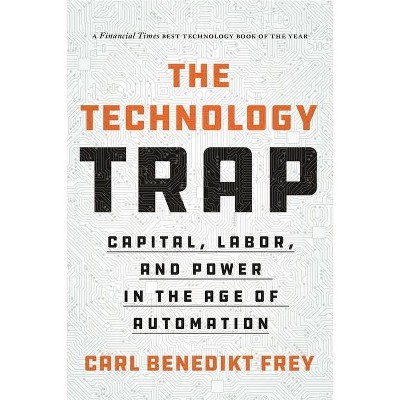
Carl Benedikt Frey is the Dieter Schwarz Associate Professor of AI and Work at the Oxford Internet Institute and Oxford Martin Citi Fellow at the Oxford Martin School, both at the University of Oxford. He is also a fellow at Mansfield College, the Institute for New Economic Thinking at Oxford, and Lund University's Department of Economic History. His books include The Technology Trap: Capital, Labor, and Power in the Age of Automation (Princeton).