Sponsored
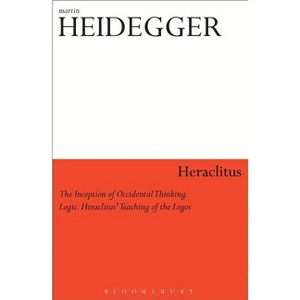
Heraclitus - by Martin Heidegger (Paperback)
In Stock
Sponsored
About this item
Highlights
- Heraclitus is the first English translation of Volume 55 of Martin Heidegger's Gesamtausgabe.
- About the Author: Martin Heidegger (1889-1976) is regarded as one of the twentieth century's most important philosophers.
- 328 Pages
- Philosophy, History & Surveys
Description
About the Book
Heidegger, one of the twentieth century's most original and important thinkers, presents an elucidation of the fragments of Heraclitus, an early Greek thinker.
Book Synopsis
Heraclitus is the first English translation of Volume 55 of Martin Heidegger's Gesamtausgabe. This important volume consists of two lecture courses given by Heidegger at the University of Freiburg over the Summers of 1943 and 1944 on the thought of Heraclitus. These lectures shed important light on Heidegger's understanding of Greek thinking, as well as his understanding of Germany, the history of philosophy, the Western world, and their shared destinies.
Review Quotes
Heidegger's Heraclitus lecture courses from 1943 and 1944 focus respectively on the notions of physis (nature) and logos (logic). They give important insight into Heidegger's attempt to think these notions ever more inceptually in the context of his being-historical thinking, and thereby to find a way to reawaken a more originary sense of being. This thoughtful translation makes accessible for the English reader Heidegger's creative and central engagement with Heraclitus.
Julia Ireland, Associate Professor of Philosophy, Whitman College, USA
The lecture courses about Heraclitus (summer 1943 and 1944) represent the real artistry of Heidegger's lecturing. This artistry consists of a unique intertwining of philosophical, political, and even poetical elements. Heidegger's interpretation of Heraclitus' fragments demonstrate an inspiring access to the beginning of Occidental thinking. The translators present a remarkable and thoughtful translation of Heidegger's intense German style. Reading Heidegger reading Heraclitus is a pleasure.
Bret W. Davis, Professor of Philosophy, Loyola University Maryland, USA
This long awaited translation was worth the wait. J. Goesser Assaiante and S. Montgomery Ewegen have provided us with a fluid and faithful translation of two of Heidegger's most sustained and important lecture courses on early Greek thinking. These manuscripts were written in 1943 and 1944, a pivotal time in Heidegger's development. They enable one to witness up close Heidegger's attempt to work out, by way of radically original translations and interpretations of Heraclitus's fragments, his understanding of the inception of the history of Occidental philosophy. At the same time, readers are invited to follow Heidegger in his attempt, by way of recovering and rethinking the deepest insights of Heraclitus and other early Greek thinkers, to think out beyond the end of the history of metaphysics that devolved from their greatness.
Andrew J. Mitchell, Winship Distinguished Research Professor of Philosophy, Emory University, USA
About the Author
Martin Heidegger (1889-1976) is regarded as one of the twentieth century's most important philosophers.
S. Montgomery Ewegen is Assistant Professor of Philosophy and Classics at Trinity College, Hartford, USA. His research and teaching are focused on Ancient philosophy, 20th Century Continental philosophy, phenomenology, and their intersections.
Julia Goesser Assaiante is a Visiting Assistant Professor of German in the Language and Culture Studies Department at Trinity College, Hartford, USA. Her research interests concentrate on eighteenth and early twentieth-century literature and philosophy, with an emphasis on poetic language, aesthetics, hermeneutics, and currents of anti-Enlightenment thought.