Sponsored
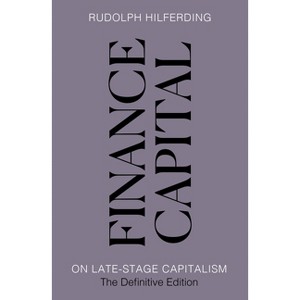
Finance Capital - by Rudolph Hilferding (Paperback)
Pre-order
Sponsored
About this item
Highlights
- New translation of a crucial study of modern capitalism, famously used by Lenin as his basis for analyzing imperialism.
- About the Author: Rudolf Hilferding (10 August 1877 - 11 February 1941) was an Austrian-born Marxist economist, socialist theorist, politician and the chief theoretician for the Social Democratic Party of Germany (SPD) during the Weimar Republic, being almost universally recognized as the SPD's foremost theoretician of the twentieth century.
- 608 Pages
- Political Science, Political Ideologies
Description
Book Synopsis
New translation of a crucial study of modern capitalism, famously used by Lenin as his basis for analyzing imperialism.
This is a new translation by Ben Fowkes of the classic book by the twentieth century German socialist leader Rudolf Hilferding, first published in 1910.
Finance Capital offers an unusual Marxist pathway towards an understanding of macroeconomics and financialisation. But the study also illuminates the background to the First World War (and indeed wars in general). It was famously used by Lenin as the basis for his analysis of imperialism. Hilferding's three-way comparison between the US, UK and German systems of finance and economics is given extra zest by his concentration on specific firms, banks, and banking systems. He pursues capital through its manifold configurations, always stressing the social meaning of individuals' actions. He demonstrates how the industrial, commercial and financial sectors of the economy became increasingly intertwined during the late 19th century, showing the impact of changes in the financial sphere on the policies of the European powers towards the non-European world, including colonial expansionism in Africa and Asia.
Hilferding's book ends with a moving exhortation to his readers to end wars by ending the rule of finance capital. This didn't happen, but his work continues to have relevance over a hundred years later.
About the Author
Rudolf Hilferding (10 August 1877 - 11 February 1941) was an Austrian-born Marxist economist, socialist theorist, politician and the chief theoretician for the Social Democratic Party of Germany (SPD) during the Weimar Republic, being almost universally recognized as the SPD's foremost theoretician of the twentieth century. He was also a physician. He was born in Vienna, where he received a doctorate having studied medicine. After becoming a leading journalist for the SPD, he participated in the November Revolution in Germany and was Finance Minister of Germany in 1923 and from 1928 to 1929. In 1933 he fled into exile, living in Zurich and then Paris, where he died in custody of the Gestapo in 1941. He was the author of many works, but Finance Capital is the one he is most famous for.
Shipping details
Return details
Guests also viewed




Discover more options