Sponsored
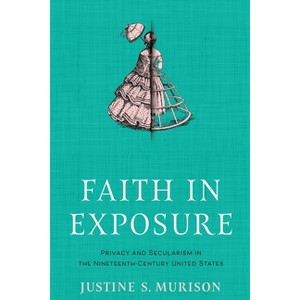
Faith in Exposure - Early American Studies by Justine S Murison Hardcover
In Stock
Sponsored
About this item
Highlights
- Recent legal history in the United States reveals a hardening tendency to treat religious freedom and sexual and reproductive freedom as competing, even opposing, claims on public life.
- About the Author: Justine S. Murison is Associate Professor of English at the University of Illinois at Urbana-Champaign and author of The Politics of Anxiety in Nineteenth-Century American Literature.
- 280 Pages
- Literary Criticism, American
- Series Name: Early American Studies
Description
About the Book
"Recent legal history in the United States reveals a hardening tendency to treat religious freedom and sexual and reproductive freedom as competing, even opposing, claims on public life. They are united, though, by the fact that both are rooted in our culture's understanding of privacy. This book shows how, over the course of the nineteenth century, privacy came to encompass such contradictions-both underpinning the right to sexual and reproductive rights but also undermining them in the name of religious freedom. Drawing on the interdisciplinary field of secular studies, this book brings a postsecular orientation to the historical emergence of modern privacy. The book explains this emergence through two interlocking stories. The first examines the legal and cultural connection of religion with the private sphere, showing how privacy became a moral concept that informs how we debate the right to be shielded from state interference, as well as who will be afforded or denied this protection. This conflation of religion with privacy gave rise, the book argues, to a "secular sensibility" that was especially invested in authenticity and the exposure of hypocrisy in others. The second story examines the development of this "secular sensibility" of privacy through nineteenth-century novels. The preoccupation of the novel form with private life, and especially its dependence on revelations of private desire and sexual secrets, made it the perfect vehicle for suggesting that exposure might be synonymous with morality itself. Each chapter places key authors into wider contexts of popular fiction and periodical press debates. From fears over religious infidelity to controversies over what constituted a modern marriage and conspiracy theories about abolitionists, these were the contests that helped privacy emerge as both a sensibility and a right in modern, secular America"--
Book Synopsis
Recent legal history in the United States reveals a hardening tendency to treat religious freedom and sexual and reproductive freedom as competing, even opposing, claims on public life. They are united, though, by the fact that both are rooted in our culture's understanding of privacy. Faith in Exposure shows how, over the course of the nineteenth century, privacy came to encompass such contradictions--both underpinning the right to sexual and reproductive rights but also undermining them in the name of religious freedom.
Drawing on the interdisciplinary field of secular studies, Faith in Exposure brings a postsecular orientation to the historical emergence of modern privacy. The book explains this emergence through two interlocking stories. The first examines the legal and cultural connection of religion with the private sphere, showing how privacy became a moral concept that informs how we debate the right to be shielded from state interference, as well as who will be afforded or denied this protection. This conflation of religion with privacy gave rise, the book argues, to a "secular sensibility" that was especially invested in authenticity and the exposure of hypocrisy in others.
The second story examines the development of this "secular sensibility" of privacy through nineteenth-century novels. The preoccupation of the novel form with private life, and especially its dependence on revelations of private desire and sexual secrets, made it the perfect vehicle for suggesting that exposure might be synonymous with morality itself. Each chapter places key authors into wider contexts of popular fiction and periodical press debates. From fears over religious infidelity to controversies over what constituted a modern marriage and conspiracy theories about abolitionists, these were the contests, Justine S. Murison argues, that helped privacy emerge as both a sensibility and a right in modern, secular America.
Review Quotes
"Brilliant...Faith in Exposure augments an already robust body of scholarship in literary studies on nineteenth-century secularism. It is among the best of these works...Today, two formations of the secular--religious freedom and the right to privacy and bodily autonomy--have seemingly opposite trajectories....Faith in Exposure is the best companion in the past year for thinking through these perennially important, now pressingly urgent questions."-- "Journal of Religion"
"The sensation of reading Murison's book is itself one of constant revelation, as her lucid explications of nineteenth-century literary, historical, and cultural phenomena illuminate our current situation--one in which the right to privacy is rapidly eroding....In revealing our past and current predicament over privacy, Faith in Exposure points to [a] better possible future."-- "Modern Philology"
"[W]hat Murison accomplishes in this book, linking the latest scholarship in secular studies to a critical genealogy of privacy in American literature, all while nodding toward (but never fixating on) the 'method wars' that have preoccupied literary criticism over the past decade, places it among the most innovative and important contributions to the study of religion in American literature in recent memory."-- "Early American Literature"
"Murison's compelling study of 'secular sensibility of privacy' is a major and original contribution to literary studies...Faith in Exposure is both theoretically and historically informed. It will help to reframe future studies of the relation between novels and private life, the relation of marriage norms to nineteenth-century culture, and women's writing about private and domestic spaces."-- "Legacy"
"Faith in Exposure is an all-too-timely study of how Americans have both valorized and violated privacy. It drives home the point that the right to privacy is not absolute or even all that comprehensive; it is now and always has been subject to public scrutiny and limitation....Americans have a long history of delightedly peering into other people's private lives and denouncing and delimiting what they find there. This privacy-breaching habit does not make them voyeurs according to this cultural logic, but rather, as Faith in Exposure explicates so well, the preservers of national morality."-- "The New England Quarterly"
"
Murison's book is not just relevant but urgent...Faith in Exposure is an accomplished work of literary history. But
perhaps its most striking payoff for an American reader right now is its account of how the conceptualization of privacy in the nineteenth-century United States shaped religious freedom and reproductive freedom into equal and opposite claims.
"Nineteenth-century Americans worried that morality would suffer when religion was made private. Faith in Exposure identifies the solution that appeased this worry--that privacy would always be made public--and the irresolvable tensions resulting from this solution. The always collapsing binaries that result, especially those of privacy/publicity and faith/proof, show why privacy is such a fragile ground for protecting rights and imagining subjectivity."-- "Gretchen Murphy, author of New England Women Writers, Secularity, and the Federalist Politics of Church and State"
"Spanning from Thomas Paine to Henry James, Faith in Exposure unearths a rich archive of late eighteenth and nineteenth-century materials and examines the shift of moral life from the public sphere of organized, state-sponsored religion to the private sphere. Beautifully written, intensively researched, and immensely important, Faith in Exposure changes how we understand secularity and offers a major contribution to nineteenth-century American religious and literary studies."-- "Claudia Stokes, author of The Altar at Home: Sentimental Literature and Nineteenth-Century American Religion"
"What is a secular sensibility? And what has it to do with the ecologies of publicity and privacy that govern American modernity? In a series of bravura readings, Justine S. Murison returns us to the tumult of the American nineteenth century, where disestablishment, abolition, and a welter of renegade faith-practices together made a complex virtue of the intimate self's artful, authentic disclosure. Faith in Exposure is a wonderful addition to the burgeoning archive of Americanist postsecular critique."-- "Peter Coviello, author of Make Yourselves Gods: Mormons and the Unfinished Business of American Secularism"
About the Author
Justine S. Murison is Associate Professor of English at the University of Illinois at Urbana-Champaign and author of The Politics of Anxiety in Nineteenth-Century American Literature.
Shipping details
Return details
Frequently bought together




Discover more options