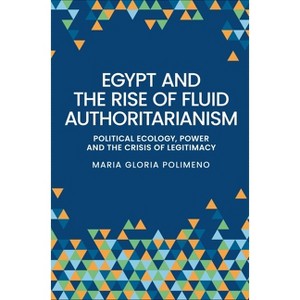
Egypt and the rise of fluid authoritarianism focuses on the sub-upgrade of the regime in Egypt and the struggle of political authorities for internal political legitimacy after 2013.
About the Author: Maria Gloria Polimeno is a Research Fellow at SOAS, University of London
296 Pages
Political Science, World
Description
About the Book
This book is a ground-breaking and intellectually engaging work on authoritarian discontinuity in Egypt after the shockwaves, and the impact this has had at the overall domestic and international political, social and economic levels. It questions political ecology and the legitimation struggle along the spectrum of sustainable development.
Book Synopsis
Egypt and the rise of fluid authoritarianism focuses on the sub-upgrade of the regime in Egypt and the struggle of political authorities for internal political legitimacy after 2013. It is an interdisciplinary work that develops a complex theoretical framework for exploring the microstructural and macrosystemic dynamics of leadership, power, political ecology, and the process of authority formation in illiberal systems that have undergone subsystemic transformations after shockwaves, also beyond Egypt. The book offers a complex, groundbreaking socio-political and economic analysis of how the forging of an internal claim to political legitimacy in Egypt eventually transformed the regime along the authoritarian spectrum, morphing into a fluid autocracy that approximates what the book defines as a 'non-exclusivist personalist regime', thereby fragmenting elites. In the second part, the book offers an economic analysis in which legitimacy and political ecology are closely intertwined. In this regard, the Social Development Goals are employed as a prism.
From the Back Cover
'This book makes an original contribution to the study of internal political legitimacy in post-shockwaves societies. The author provides a conceptual framework which sheds light on the rise of "fluid authoritarianism" as a subset of political and socioeconomic ruptures and continuities as well. Essential reading.' Fawaz Gerges, Professor of International Relations 'Polimeno offers a theoretically informed account of the distinctive bases of authoritarianism in Egypt since the fall of Mubarak, highlighting the ways in which internal and external survival strategies are reflected in the Sisi regime's legitimation discourse. The book moves beyond cursory understandings of "authoritarianism" to show how - albeit often fragile - power is organised within a range of spheres including law, religion and political economy.' Ewan Stein, Senior Lecturer in International Relations Egypt and the rise of fluid authoritarianism engages with regime discontinuity and the implications this rupture determines. It does this at the structural, political and economic level, domestically and along the international spectrum, by questioning the institutionalisation of nature along the legitimation process. After the military coup of 2013, Egypt entered a phase of internal transition, where authorities attempted to forge a legitimation claim with former and new actors that emerged in the post-2013 panorama. However, this eventually led to a micro-structural re-organisation of infrastructural relations, which impacted the overall identity of the regime turning it into a fluid authoritarianism that added a non-exclusivist personalist sub-trait to the identity of the system. This resonated not only at a political but also an economic level. Based on extensive research and fieldwork the book offers a concise overview of authoritarian adaptations and legitimation in the Middle East.
Review Quotes
'This book makes an original contribution to the study of internal political legitimacy in post-shockwaves societies. Examining Egypt which experienced a coup one year after democratic elections in 2012, the author provides a conceptual framework which sheds light on the rise of "fluid authoritarianism" as a subset of political and socioeconomic ruptures and continuities as well. Essential reading.' Fawaz Gerges, Professor of International Relations and author of What Really Went Wrong: The West and the Failure of Democracy in the Middle East (Yale University Press, 2024)
'Polimeno offers a theoretically informed account of the distinctive bases of authoritarianism in Egypt since the fall of Mubarak, highlighting the ways in which internal and external survival strategies are reflected in the Sisi regime's legitimation discourse. The book moves beyond cursory understandings of "authoritarianism" to show how - albeit often fragile - power is organised within a range of spheres including law, religion and political economy.' Ewan Stein, Senior Lecturer in International Relations
About the Author
Maria Gloria Polimeno is a Research Fellow at SOAS, University of London
Dimensions (Overall): 9.21 Inches (H) x 6.14 Inches (W) x .69 Inches (D)
Weight: 1.32 Pounds
Suggested Age: 22 Years and Up
Number of Pages: 296
Genre: Political Science
Sub-Genre: World
Publisher: Manchester University Press
Theme: Middle Eastern
Format: Hardcover
Author: Maria Gloria Polimeno
Language: English
Street Date: December 10, 2024
TCIN: 91682530
UPC: 9781526176608
Item Number (DPCI): 247-02-3190
Origin: Made in the USA or Imported
If the item details aren’t accurate or complete, we want to know about it.
Shipping details
Estimated ship dimensions: 0.69 inches length x 6.14 inches width x 9.21 inches height
Estimated ship weight: 1.32 pounds
We regret that this item cannot be shipped to PO Boxes.
This item cannot be shipped to the following locations: American Samoa (see also separate entry under AS), Guam (see also separate entry under GU), Northern Mariana Islands, Puerto Rico (see also separate entry under PR), United States Minor Outlying Islands, Virgin Islands, U.S., APO/FPO
Return details
This item can be returned to any Target store or Target.com.
This item must be returned within 90 days of the date it was purchased in store, shipped, delivered by a Shipt shopper, or made ready for pickup.