Sponsored
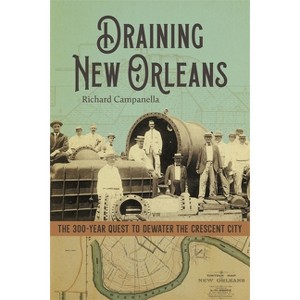
Draining New Orleans - by Richard Campanella Hardcover
In Stock
Sponsored
About this item
Highlights
- In Draining New Orleans, the first full-length book devoted to "the world's toughest drainage problem," renowned geographer Richard Campanella recounts the epic challenges and ingenious efforts to dewater the Crescent City.
- About the Author: Richard Campanella is a geographer and associate dean for research at the Tulane School of Architecture.
- 424 Pages
- History, United States
Description
About the Book
"Draining New Orleans is the first full-length book entirely devoted to one of the world's most challenging drainage problems: the reclamation and drainage of a fluvial delta for the development of the City of New Orleans. Renowned Crescent City geographer and historian Richard Campanella introduces readers to the epic challenges and ingenious efforts to dewater New Orleans. With forays into geography, public health, engineering, architecture, politics, sociology, race relations, and disaster response, he recovers the herculean effort to 'reclaim' the city's swamps and marshes and install subsurface drainage for urbanization. This is not a story about mud; rather, it is a history of people, power, and the making of place. Campanella emphasizes the role of empowered, colorful individuals who spearheaded efforts to separate water from dirt and create value in the process not only for the community, but also for themselves. Campanella opens with a festive scene on Mardi Gras weekend 1915, in which an elaborate parade for 'the Drainage King'--a local hero by the serendipitous name of George Hero--brought an elite entourage to the edge of the Barataria swamp to witness the activation of gigantic pumps, via a telephonic connection to President Woodrow Wilson in the White House. What transpired in the years and decades ahead can only be understood by going back two centuries-to the geological formation and indigenous occupation of this delta and continuing through the colonial, antebellum, postbellum, and Progressive eras to modern times. The consequences of the dewatering of New Orleans are both triumphant and tragic. The city's engineering prowess made it a world leader in drainage technology, yet also a vulnerable victim of its own success. And by no means is the story over, for amid the uncertainty wrought by soil subsidence, coastal erosion, and climate change, the next generation of drainage experts are striving to improve on the past by doing something utterly inconceivable to their predecessors: rewatering New Orleans"--
Book Synopsis
In Draining New Orleans, the first full-length book devoted to "the world's toughest drainage problem," renowned geographer Richard Campanella recounts the epic challenges and ingenious efforts to dewater the Crescent City. With forays into geography, public health, engineering, architecture, politics, sociology, race relations, and disaster response, he chronicles the herculean attempts to "reclaim" the city's swamps and marshes and install subsurface drainage for massive urban expansion.
The study begins with a vivid description of a festive event on Mardi Gras weekend 1915, which attracted an entourage of elite New Orleanians to the edge of Bayou Barataria to witness the christening of giant water pumps. President Woodrow Wilson, connected via phoneline from the White House, planned to activate the station with the push of a button, effectively draining the West Bank of New Orleans. What transpired in the years and decades that followed can only be understood by examining the large swath of history dating back two centuries earlier--to the geological formation and indigenous occupation of this delta--and extending through the colonial, antebellum, postbellum, and Progressive eras to modern times.
The consequences of dewatering New Orleans proved both triumphant and tragic. The city's engineering prowess transformed it into a world leader in drainage technology, yet the municipality also fell victim to its own success. Rather than a story about mud and machinery, this is a history of people, power, and the making of place. Campanella emphasizes the role of determined and sometimes unsavory individuals who spearheaded projects to separate water from dirt, creating lucrative opportunities in the process not only for the community but also for themselves.
Review Quotes
"Clearly written, grounded in science, the book aims to understand, epoch by epoch, how the cumulative weight of unforeseeable consequences saved many millions of people while life in the shadow of levees became more hazardous."--Journal of American History
"Geographer Campanella has authored numerous books about New Orleans. . . . This new work is one of his best. . . . Campanella provides a well-documented account of how past public works, public health concerns, race relations, natural disasters, environmentalism, and Louisiana politics influenced drainage choices. His prose is excellent and his arguments well stated."--CHOICE
About the Author
Richard Campanella is a geographer and associate dean for research at the Tulane School of Architecture. He is the author of fourteen books, including The West Bank of Greater New Orleans and Cityscapes of New Orleans, as well as hundreds of articles on Louisiana history and geography.
Shipping details
Return details
Frequently bought together





Discover more options