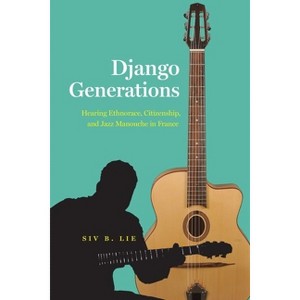
Django Generations shows how relationships between racial identities, jazz, and national belonging become entangled in France.
Author(s): Siv B Lie
248 Pages
Music, Genres & Styles
Series Name: Chicago Studies in Ethnomusicology
Description
About the Book
"The distinctive sound of the swing-driven guitar style of Django Reinhardt has become almost synonymous with a carefree, bohemian Frenchness to fans all over the world. However, we in the US refer to his music using a telling designation: Django is known here as the father of gypsy jazz. In France, the cultural significance of the musical style--called jazz manouche in reference to his origins in the Manouche subgroup of Romanies (known pejoratively as "Gypsies")--is fraught both for the Manouche and for the white French men and women eager to claim Django as a native son. In Django Generations, ethnomusicologist Siv B. Lie explores the complicated ways in which Django's legacy and jazz manouche express competing notions of what it means to be French. Though jazz manouche is overwhelmingly popular in France, Manouche people are more often treated as outsiders. However, some Manouche people turn to their musical heritage to gain acceptance in mainstream French society. Considering all of the characteristics and roles attributed to Django--as a world-renowned jazz musician, as an artistic pioneer, as a representative of French heritage, and as a Manouche--jazz manouche becomes a potent means for performers and listeners to articulate their relationships with French society, actual or hoped-for. Weaving together a history of jazz manouche and ethnographic fieldwork undertaken in the bars, festivals, family events, and cultural organizations where jazz manouche is performed and celebrated, Lie offers insight into how a musical genre can channel arguments about national and ethnoracial belonging. She argues that an uncomfortable cohabitation of Manouche identity and French identity lies at the heart of jazz manouche, which is what makes it so successful and powerful"--
Book Synopsis
Django Generations shows how relationships between racial identities, jazz, and national belonging become entangled in France.
Jazz manouche--a genre known best for its energetic, guitar-centric swing tunes--is among France's most celebrated musical practices of the twentieth and twenty-first centuries. It centers on the recorded work of famed guitarist Django Reinhardt and is named for the ethnoracial subgroup of Romanies (also known, often pejoratively, as "Gypsies") to which Reinhardt belonged. French Manouches are publicly lauded as bearers of this jazz tradition, and many take pleasure and pride in the practice while at the same time facing pervasive discrimination. Jazz manouche uncovers a contradiction at the heart of France's assimilationist republican ideals: the music is portrayed as quintessentially French even as Manouches themselves endure treatment as racial others.
In this book, Siv B. Lie explores how this music is used to construct divergent ethnoracial and national identities in a context where discussions of race are otherwise censured. Weaving together ethnographic and historical analysis, Lie shows that jazz manouche becomes a source of profound ambivalence as it generates ethnoracial difference and socioeconomic exclusion. As the first full-length ethnographic study of French jazz to be published in English, this book enriches anthropological, ethnomusicological, and historical scholarship on global jazz, race and ethnicity, and citizenship while showing how music can be an important but insufficient tool in struggles for racial and economic justice.
Review Quotes
"In this book, Siv B. Lie explores the paradoxes of jazz manouche's history and its relationship to the Manouche community without taking sides in the complex debates between musicians, institutions, and the industry. Django Generations is a work of considerable intellectual sophistication."--Andy Fry, King's College London
"Django Generations offers a profound analysis of how Manouche Romanies navigate French denials of race and racism through what Siv B. Lie calls 'ambivalent essentialism'--the set of incompatible qualities ascribed by and to this ethnicized and racialized group whose most famous ancestor is the guitarist Django Reinhardt. Drawing on deep ethnographic and historical research, Lie brilliantly develops a semiotic framework that both explicates the development and negotiation of local identities in jazz manouche and their connection to much broader processes of managing marginalization and the exigencies of capitalism.""--Ingrid Monson, Quincy Jones Professor of African American Music, Harvard University
"A necessary addition for ethnomusicologists and scholars of Romani music, Django Generations is aptly named because it gives voice to groups of Romani musicians who are forging contemporary identities in modern contexts while acknowledging past histories and cultural roots."--Adriana Helbig, University of Pittsburgh
Dimensions (Overall): 9.0 Inches (H) x 6.0 Inches (W) x .69 Inches (D)
Weight: 1.19 Pounds
Suggested Age: 22 Years and Up
Number of Pages: 248
Genre: Music
Sub-Genre: Genres & Styles
Series Title: Chicago Studies in Ethnomusicology
Publisher: University of Chicago Press
Theme: Jazz
Format: Hardcover
Author: Siv B Lie
Language: English
Street Date: October 26, 2021
TCIN: 1008784538
UPC: 9780226810812
Item Number (DPCI): 247-27-9241
Origin: Made in the USA or Imported
If the item details aren’t accurate or complete, we want to know about it.
Shipping details
Estimated ship dimensions: 0.69 inches length x 6 inches width x 9 inches height
Estimated ship weight: 1.19 pounds
We regret that this item cannot be shipped to PO Boxes.
This item cannot be shipped to the following locations: American Samoa (see also separate entry under AS), Guam (see also separate entry under GU), Northern Mariana Islands, Puerto Rico (see also separate entry under PR), United States Minor Outlying Islands, Virgin Islands, U.S., APO/FPO
Return details
This item can be returned to any Target store or Target.com.
This item must be returned within 90 days of the date it was purchased in store, shipped, delivered by a Shipt shopper, or made ready for pickup.