Sponsored
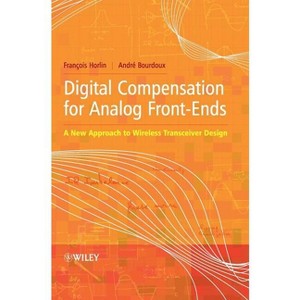
Digital Compensation for Analo - by François Horlin & André Bourdoux Hardcover
In Stock
Sponsored
About this item
Highlights
- The desire to build lower cost analog front-ends has triggered interest in a new domain of research.
- About the Author: Fran?ois Horlin recently became a Professor at the "Université Libre de Bruxelles" (ULB), Brussels, Belgium.
- 280 Pages
- Technology, Telecommunications
Description
Book Synopsis
The desire to build lower cost analog front-ends has triggered interest in a new domain of research. Consequently the joint design of the analog front-end and of the digital baseband algorithms has become an important field of research. It enables the wireless systems and chip designers to more effectively trade the communication performance with the production cost.
Digital Compensation for Analog Front-Ends provides a systematic approach to designing a digital communication system. It covers in detail the digital compensation of many non-idealities, for a wide class of emerging broadband standards and with a system approach in the design of the receiver algorithms. In particular, system strategies for joint estimation of synchronization and front-end non-ideality parameters are emphasized. The book is organized to allow the reader to gradually absorb the important information and vast quantity of material on this subject. The first chapter is a comprehensive introduction to the emerging wireless standards which is followed by a detailed description of the front-end non-idealities in chapter two. Chapter three then uses this information to explore what happens when the topics introduced in the first two chapters are merged. The book concludes with two chapters providing an in-depth coverage of the estimation and compensation algorithms.
This book is a valuable reference for wireless system architects and chip designers as well as engineers or managers in system design and development. It will also be of interest to researchers in industry and academia, graduate students and wireless network operators.
- Presents a global, systematic approach to the joint design of the analog front-end compensation, channel estimation, synchronization and of the digital baseband algorithms
- Describes in depth the main front-end non-idealities such as phase noise, IQ imbalance, non-linearity, clipping, quantization, carrier frequency offset, sampling clock offset and their impact on the modulation
- Explains how the non-idealities introduced by the analog front-end elements can be compensated digitally
- Methodologies are applied to the emerging Wireless Local Area Network and outdoor Cellular communication systems, hence covering OFDM(A), SC-FDE and MIMO
- Written by authors with in-depth expertise developed in the wireless research group of IMEC and projects covering the main broadband wireless standards
From the Back Cover
The desire to build lower cost analog front-ends has triggered interest in a new domain of research. Consequently the joint design of the analog front-end and of the digital baseband algorithms has become an important field of research. It enables the wireless systems and chip designers to more effectively trace the communication performance with the production cost.
Digital Compensation for Analog Front-Ends provides a systematic approach to designing a digital communication system. It covers in detail the digital compensation of many non-idealities, for a wide class of emerging broadband standards and with a system approach in the design of the receiver algorithms. In particular, system strategies for joint estimation of synchronization and front-end non-ideality parameters are emphasized. The book is organized to allow the reader to gradually absorb the important information and vast quantity of material on this subject. The first chapter is a comprehensive introduction to the emerging wireless standards which is followed by a detailed description of the front-end non-idealities in chapter two. Chapter three then uses this information to explore what happens when the topics introduced in the first two chapters are merged. the book concludes with two chapters providing an in-depth coverage of the estimation and compensation algorithms.
- Presents a global, systematic approach to the joint design of the analog front-end compensation, channel estimation, synchronization and of the digital baseband algorithms
- Describes in depth the main front-end idealities such as phase noise, IQ imbalance, non-linearity, clipping, quantization, carrier frequency offset, sampling clock offset and their impact on the modulation
- Explains how the non-idealities introduced by the analog front-end elements can be compensated digitally
- Methodologies are applied to the emerging Wireless Local Area network and outdoor Cellular communication systems, hence covering OFDM(A), SC-FDE and MIMO
- Written by authors with in-depth expertise developed in the Wireless Research group of IMEC and projects covering the main broadband wireless standards.
This book is a valuable reference for wireless system architects and chip designers as well as engineers or managers in system design and development. It will also be of interest to researchers in industry and academia, graduate students and wireless network operators.
About the Author
Fran?ois Horlin recently became a Professor at the "Université Libre de Bruxelles" (ULB), Brussels, Belgium. Prior to this he worked at the Wireless Research group of the Inter-university Micro-Electronic Center (IMEC), Leuven, Belgium, as a senior researcher, leading the research activities on digital signal processing for broadband communications. His fields of interests have always been in digital signal processing (DSP), mainly for high bit rate multi-user communications. He received an electrical engineering degree and Ph.D. from the "Université catholique de Louvain" (UCL), Louvain-la-Neuve, Belgium, in 1998 and 2002 respectively.
André Bourdoux is a senior scientist in the Wireless Research group of the Inter-university Micro-Electronic Center (IMEC). He currently coordinates the research on millimeter-wave communications, helping antenna specialists, analog designers and DSP specialists to align their research efforts. Before joining IMEC, he was with Bats, Belgium, working first as an R&D engineer, then as a system engineer, mainly on radar systems. He received an MSc in Electrical Engineering (specialisation in micro-electronics) in 1982 from the Université catholique de Louvain (UCL), Belgium.
Shipping details
Return details
Trending Computers & Technology Books






Discover more options