Sponsored
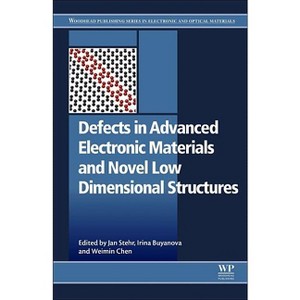
Defects in Advanced Electronic Materials and Novel Low Dimensional Structures - Woodhead Publishing Electronic and Optical Materials Paperback
In Stock
Sponsored
About this item
Highlights
- Defects in Advanced Electronic Materials and Novel Low Dimensional Structures provides a comprehensive review on the recent progress in solving defect issues and deliberate defect engineering in novel material systems.
- About the Author: Dr. Stehr is the Lab Manager at the Swedish Interdisciplinary Magnetic Resonance Center.
- 306 Pages
- Technology, Materials Science
- Series Name: Woodhead Publishing Electronic and Optical Materials
Description
About the Book
"Defects in Advanced Electronic Materials and Novel Low Dimensional Structures provides a comprehensive review on the recent progress in solving defect issues and deliberate defect engineering in novel material systems. It begins with an overview of point defects in ZnO and group-III nitrides, including irradiation-induced defects, and then look at defects in one and two-dimensional materials, including carbon nanotubes and graphene. Next, it examines the ways that defects can expand the potential applications of semiconductors, such as energy upconversion and quantum processing. The book concludes with a look at the latest advances in theory. While defect physics is extensively reviewed for conventional bulk semiconductors, the same is far from being true for novel material systems, such as low-dimensional 1D and 0D nanostructures and 2D monolayers. This book fills that necessary gap.Presents an in-depth overview of both conventional bulk semiconductors and low-dimensional, novel material systems, such as 1D structures and 2D monolayersAddresses a range of defects in a variety of systems, providing a comparative approachIncludes sections on advances in theory that provide insights on where this body of research might lead"--
Book Synopsis
Defects in Advanced Electronic Materials and Novel Low Dimensional Structures provides a comprehensive review on the recent progress in solving defect issues and deliberate defect engineering in novel material systems. It begins with an overview of point defects in ZnO and group-III nitrides, including irradiation-induced defects, and then look at defects in one and two-dimensional materials, including carbon nanotubes and graphene. Next, it examines the ways that defects can expand the potential applications of semiconductors, such as energy upconversion and quantum processing. The book concludes with a look at the latest advances in theory.
While defect physics is extensively reviewed for conventional bulk semiconductors, the same is far from being true for novel material systems, such as low-dimensional 1D and 0D nanostructures and 2D monolayers. This book fills that necessary gap.
About the Author
Dr. Stehr is the Lab Manager at the Swedish Interdisciplinary Magnetic Resonance Center. In 2015 he received the Corbett Prize for outstanding young researchers and the International Association of Advanced Materials young scientist award. He has given a number of invited talks at international conferences and has been awarded multiple grants for his research.
Shipping details
Return details
Trending Computers & Technology Books