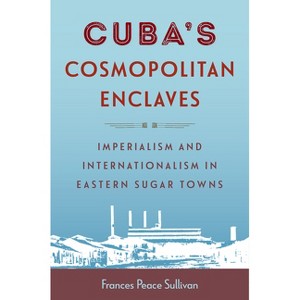
How northeastern Cuba became a hub of internationalsolidarity and transnational movements in the 1920s and 1930s This book exploreshow a region in Cuba that was widely known as a site of labor subjugationbecame a hub of international solidarity in the 1920s and 1930s.
Author(s): Frances Peace Sullivan
298 Pages
History, Caribbean & West Indies
Series Name: Caribbean Crossroads: Race, Identity, and Freedom Struggles
Description
About the Book
This book explores how northeastern Cuba became a hub of international solidarity and transnational movements in the 1920s and 1930s, showing how the Oriente Province emerged as a focal point for global visions of resistance.
Book Synopsis
How northeastern Cuba became a hub of international solidarity and transnational movements in the 1920s and 1930s
This book explores how a region in Cuba that was widely known as a site of labor subjugation became a hub of international solidarity in the 1920s and 1930s. In the early twentieth century, United States agricultural companies like the United Fruit Company established sugar export operations in Cuba's Oriente Province, creating a zone of economic imperialism. These early multinational corporations recruited Afro-Caribbean laborers from surrounding islands, aiming to create closed, self-sufficient plantation complexes.
However, as Frances Peace Sullivan shows in Cuba's Cosmopolitan Enclaves, the influx of foreign capital led to the development of diverse, vibrant communities in these company towns. Drawing on archival sources in Cuba, the US, Russia, and the UK, Sullivan demonstrates how immigrant workers joined local Cubans in movements for radical transnational solidarity. In the interwar years, northeastern Cuba became a center of Garveyite Pan-Africanism, global communism, and antifascist support for Republican Spain. In 1933, the region attracted the world's attention when workers seized sugar mills in a revolutionary strike.
Placing northeastern Cuba at the heart of the history of interwar internationalism, Sullivan shows how Oriente emerged as a focal point for visions of resistance. Cuba's Cosmopolitan Enclaves reveals how workers seized pathways created by imperialist companies and used them to advance their own goals. In this focused study, Sullivan offers a detailed portrait of how ordinary people became leaders in transnational radicalism.
A volume in the series Caribbean Crossroads: Race, Identity, and Freedom Struggles, edited by Lillian Guerra, Devyn Spence Benson, April Mayes, and Solsiree del Moral
Dimensions (Overall): 9.21 Inches (H) x 6.14 Inches (W) x .81 Inches (D)
Weight: 1.31 Pounds
Suggested Age: 22 Years and Up
Number of Pages: 298
Genre: History
Sub-Genre: Caribbean & West Indies
Series Title: Caribbean Crossroads: Race, Identity, and Freedom Struggles
Publisher: University of Florida Press
Theme: Cuba
Format: Hardcover
Author: Frances Peace Sullivan
Language: English
Street Date: May 27, 2025
TCIN: 1004472119
UPC: 9781683405115
Item Number (DPCI): 247-42-4852
Origin: Made in the USA or Imported
If the item details aren’t accurate or complete, we want to know about it.
Shipping details
Estimated ship dimensions: 0.81 inches length x 6.14 inches width x 9.21 inches height
Estimated ship weight: 1.31 pounds
We regret that this item cannot be shipped to PO Boxes.
This item cannot be shipped to the following locations: American Samoa (see also separate entry under AS), Guam (see also separate entry under GU), Northern Mariana Islands, Puerto Rico (see also separate entry under PR), United States Minor Outlying Islands, Virgin Islands, U.S., APO/FPO
Return details
This item can be returned to any Target store or Target.com.
This item must be returned within 90 days of the date it was purchased in store, shipped, delivered by a Shipt shopper, or made ready for pickup.