Sponsored
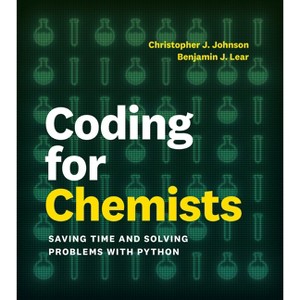
Coding for Chemists - by Benjamin J Lear & Christopher J Johnson (Paperback)
Pre-order
Sponsored
About this item
Highlights
- A chemistry-driven pathway to learning Python that empowers chemists to use coding as a practical tool for planning experiments, visualizing results, and interpreting chemical behavior.
- About the Author: Benjamin J. Lear is Professor of Chemistry at The Pennsylvania State University, where he leads a physical-inorganic research group that currently focuses on interactions between inorganic materials and their near-chemical environment.
- 488 Pages
- Computers + Internet, Programming Languages
Description
Book Synopsis
A chemistry-driven pathway to learning Python that empowers chemists to use coding as a practical tool for planning experiments, visualizing results, and interpreting chemical behavior.
This approachable textbook introduces coding in Python as a tool for solving real-world problems encountered by experimental chemists and uses a narrative structure that frames coding concepts in terms of tasks common to chemical research. Readers will learn to plan experiments, automate the generation of publication-quality figures, fit experimental data to any desired model, and process data using advanced analysis techniques. By working through this book, readers with no prior knowledge of coding will learn to efficiently expand their research and data analysis skills.
- Introduces concepts and workflows applicable to nearly all experimental chemists
- Assumes no prior knowledge of coding
- Ensures that each concept introduced is immediately useful to the reader
- Tackles key pain points familiar to any advanced undergraduate chemistry student with usable code
About the Author
Benjamin J. Lear is Professor of Chemistry at The Pennsylvania State University, where he leads a physical-inorganic research group that currently focuses on interactions between inorganic materials and their near-chemical environment.
Christopher J. Johnson is Professor of Chemistry at Stony Brook University, where he runs a research group that focuses on developing instruments to study atmospheric and inorganic nanoparticles.