Sponsored
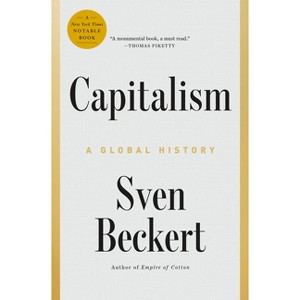
Capitalism - by Sven Beckert (Hardcover)
In Stock
Sponsored
About this item
Highlights
- A New York Times Notable Book - A Financial Times Best Book of the Year "A learned, formidable and vivid story... Readers around the world will study and ponder this monumental work of history, agreeing and arguing with it, all the while affirming its generational importance, for decades to come.
- About the Author: Sven Beckert is the Laird Bell Professor of History at Harvard University.
- 1344 Pages
- Business + Money Management, Economic History
Description
About the Book
"A landmark event years in the making, a brilliant global narrative that unravels the defining story of the past thousand years of human history. No other phenomenon has shaped human history as decisively as capitalism. It structures how we live and work, how we think about ourselves and others, how we organize our politics. Sven Beckert, author of the Bancroft Prize-winning Empire of Cotton, places the story of capitalism within the largest conceivable geographical and historical framework, tracing its history during the past millennium and across the world. An epic achievement, his book takes us into merchant businesses in Aden and car factories in Turin, onto the terrifyingly violent sugar plantations in Barbados, and within the world of women workers in textile factories in today's Cambodia. Capitalism, argues Beckert, was born global. Emerging from trading communities across Asia, Africa, and Europe, capitalism's radical recasting of economic life rooted itself only gradually. But then it burst onto the world scene, as a powerful alliance between European states and merchants propelled them, and their economic logic, across the oceans. This, Beckert shows, was modern capitalism's big bang, and one of its epicenters was the slave labor camps of the Caribbean. This system, with its hierarchies that haunt us still, provided the liftoff for the radical transformations of the Industrial Revolution. Fueled by vast productivity increases along with coal and oil, capitalism pulled down old ways of life to crown itself the defining force of the modern world. This epic drama, shaped by state-backed institutions and imperial expansion, corresponded at no point to an idealized dream of free markets. Drawing on archives on six continents, Capitalism locates important modes of agency, resistance, innovation, and ruthless coercion everywhere in the world, opening the aperture from heads of state to rural cultivators. Beckert shows that despite the dependence on expansion, there always have been, and are still, areas of human life that the capitalist revolution has yet to reach."--
Book Synopsis
A New York Times Notable Book - A Financial Times Best Book of the Year
"A learned, formidable and vivid story... Readers around the world will study and ponder this monumental work of history, agreeing and arguing with it, all the while affirming its generational importance, for decades to come." -- Marcus Rediker, The New York Times
"Epic... Read this book and you will learn innumerable things you did not previously know culled from places you have never been... [Readers], including me, will be genuinely grateful for exposure to this breadth of scholarship and be glad to have a valuable tool of reference on their shelves." -John Kay, Financial Times
A landmark event years in the making, a brilliant global narrative that unravels the defining story of the past thousand years of human history
No other phenomenon has shaped human history as decisively as capitalism. It structures how we live and work, how we think about ourselves and others, how we organize our politics. Sven Beckert, author of the Bancroft Prize-winning Empire of Cotton, places the story of capitalism within the largest conceivable geographical and historical framework, tracing its history during the past millennium and across the world. An epic achievement, his book takes us into merchant businesses in Aden and car factories in Turin, onto the terrifyingly violent sugar plantations in Barbados, and within the world of women workers in textile factories in today's Cambodia.
Capitalism, argues Beckert, was born global. Emerging from trading communities across Asia, Africa, and Europe, capitalism's radical recasting of economic life rooted itself only gradually. But then it burst onto the world scene, as a powerful alliance between European states and merchants propelled them, and their economic logic, across the oceans. This, Beckert shows, was modern capitalism's big bang, and one of its epicenters was the slave labor camps of the Caribbean. This system, with its hierarchies that haunt us still, provided the liftoff for the radical transformations of the Industrial Revolution. Fueled by vast productivity increases along with coal and oil, capitalism pulled down old ways of life to crown itself the defining force of the modern world. This epic drama, shaped by state-backed institutions and imperial expansion, corresponded at no point to an idealized dream of free markets.
Drawing on archives on six continents, Capitalism locates important modes of agency, resistance, innovation, and ruthless coercion everywhere in the world, opening the aperture from heads of state to rural cultivators. Beckert shows that despite the dependence on expansion, there always have been, and are still, areas of human life that the capitalist revolution has yet to reach.
By chronicling capitalism's global history, Beckert exposes the reality of the system that now seems simply "natural." It is said that people can more easily imagine the end of the world than the end of capitalism. If there is one ultimate lesson in this extraordinary book, it's how to leave that behind. Though cloaked in a false timelessness and universality, capitalism is, in reality, a recent human invention. Sven Beckert doesn't merely tote up capitalism's debits and credits. He shows us how to look through and beyond it to imagine a different and larger world.
Review Quotes
"A seminal work that explains how capitalism started, evolved, and expanded over the last several hundred years. It's quotable because the details are so rich and interesting, especially how capitalism started with merchants in a little known area called Aden." --Forbes
"Capitalism is a learned, formidable and vivid story. Its grand synthesis will engage not only general readers, but thousands of specialists... Readers around the world will study and ponder this monumental work of history, agreeing and arguing with it, all the while affirming its generational importance, for decades to come." -- Marcus Rediker, The New York Times
"Beckert's bravura new intellectual history sets the record straight... Panoramic... While scholars have illuminated bits and pieces of this immense narrative, Beckert's massive volume brings it together with impeccable authority and perspicacity... Each chapter offers an abundance of characters and arguments, interpreting the economic and social realities we share, commonalities of revolution and change... An achievement that will endure alongside Tony Judt's Postwar and Thomas Piketty's Capital in the 21st Century, whose influence undergirds Beckert's book." --The Boston Globe
"Vast in scale, cogent in delivery, accessible enough to accommodate a non-economist like me, [Capitalism] is that rare kind of project that can be described -- unironically, no less -- as magisterial." --NPR.org
"Supremely ambitious, an insightful and well-illustrated history by the Harvard historian who has been a pioneer in the creation of new narratives exploring how an ever-changing capitalism has been a socially and culturally rooted phenomenon. At well over a thousand pages, Beckert's volume offers a synthesis and occasional recasting of almost everything we have learned about the history of capitalism, and not just in the closely studied societies bordering the North Atlantic . . . Beckert . . . [writes] eloquently of the panics, booms, and busts that became a characteristic of world capitalism from the early nineteenth century through our own time. But the expansion of trade and production remains at the heart of his book . . . But whatever its fate, Beckert's capacious volume provides a new generation of capitalists and anti-capitalists with plenty of precedents for whatever world they come to imagine." --Jacobin
"An early contender for a Pulitzer, Sven Beckert's readable, never dull doorstop of how more people came to believe in the end of the world than the end of capitalism." --Chicago Tribune, Fall Books Preview
"Epic . . . An unparalleled work of scholarship that is also a joy to read, this is a monumental achievement." --Publishers Weekly (starred review)
"A clarity that Karl Marx could only long for . . . Beckert's agile account marches through the emergence of mercantilism and the invention of double-entry bookkeeping and proceeds through plantation and wage slavery, colonialism and postcolonialism, and a managerial/bureaucratic golden age . . . A comprehensive and up-to-date history, essential." --Kirkus (starred review)
"Magisterial in scope and ambition, Sven Beckert's Capitalism is a dazzling global history of the forces that have shaped--and continue to shape--our world. A true tour de force." --Peter Frankopan, Professor of Global History at Oxford University and author of The Silk Roads: A New History of the World
"Sven Beckert is one of the world's preeminent scholars on the history of capitalism, and in this monumentally important single-volume global history, simply titled Capitalism, he upends the deeply embedded notion that capitalism was born as a purely Western phenomenon. Instead, he powerfully demonstrates how its ascendancy over the last six centuries depended both on the genius and vibrancy of interconnected communities and on brutally exploitative systems, including slavery. Drawing on astonishing research across multiple continents, Beckert's new book is a landmark achievement that reorients our understanding of capitalism as an evolving, ever-contested human creation. It is certain to become a canonical work of history." --Henry Louis Gates, Jr., Alphonse Fletcher University Professor, Harvard University
"It's hard to think of any other contemporary historian who could have written a new history of capitalism of such global scope and impressive scale. Capitalism promises to be an instant classic that will last." --Isabella Weber, author of How China Escaped Shock Therapy
"Sven Beckert has written what will surely become a key reference on the global history of modern capitalism. A monumental book, a must-read." --Thomas Piketty, author of Capital in the Twenty-First Century
"In this magnificent history of capitalism, Sven Beckert presents an exceptionally illuminating account of the thousand years of what he calls (correctly, I think) 'the most impactful revolution the world has ever seen.' Beginning with the rapid expansion of trade and capital around the port of Aden in the twelfth century, the gripping history comes all the way to our time, telling us about commerce, technology and innovations, but also about people's lives, worries and questions. One of the striking features of this splendid book is the avoidance of Eurocentrism in telling the story of capitalism. The global history, in this case, is truly global." --Amartya Sen, Winner of the Nobel Prize in Economics
About the Author
Sven Beckert is the Laird Bell Professor of History at Harvard University. Holding a PhD from Columbia University, he has written widely on the economic, social, and political history of capitalism. His book Empire of Cotton won the Bancroft Prize, was a finalist for the Pulitzer Prize, and was named one of the ten best books of the year by The New York Times. An elected member of the American Academy of Arts and Sciences, he lives in Cambridge, Massachusetts.
Shipping details
Return details
Frequently bought together





Guests also viewed






Discover more options