Sponsored
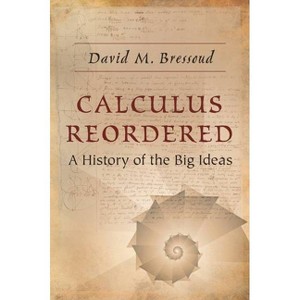
Calculus Reordered - by David M Bressoud
In Stock
Sponsored
About this item
Highlights
- A look at how calculus has evolved over hundreds of years and why calculus pedagogy needs to change Calculus Reordered tells the remarkable story of how calculus grew over centuries into the subject we know today.
- About the Author: David M. Bressoud is DeWitt Wallace Professor Emeritus at Macalester College and Director of the Conference Board of the Mathematical Sciences.
- 248 Pages
- Mathematics, Calculus
Description
Book Synopsis
A look at how calculus has evolved over hundreds of years and why calculus pedagogy needs to change
Calculus Reordered tells the remarkable story of how calculus grew over centuries into the subject we know today. David Bressoud explains why calculus is credited to seventeenth-century figures Isaac Newton and Gottfried Leibniz, how it was shaped by Italian philosophers such as Galileo Galilei, and how its current structure sprang from developments in the nineteenth century. Bressoud reveals problems with the standard ordering of its curriculum--limits, differentiation, integration, and series--and he argues that a pedagogy informed by the historical evolution of calculus represents a sounder way for students to learn this fascinating area of mathematics. From calculus's birth in the Hellenistic Eastern Mediterranean, India, and the Islamic Middle East, to its contemporary iteration, Calculus Reordered highlights the ways this essential tool of mathematics came to be.
Review Quotes
"As far as I know, there is no other book that integrates the history, theory, and pedagogy of calculus as well as this one. David Bressoud has long experience in these aspects of calculus and provides a masterly and lucid treatment of the subject."--John Stillwell, University of San Francisco-- "Mathemafrica"
"I wish David Bressoud's beautifully and accessibly written book had been available to me back when I was a mathematics student. By tracing the trail of ideas and advances in calculus over many centuries, his account brings to life a story not of a small number of isolated geniuses, as is usually told, but rather a wonderful march forward, pursued by a great many individuals on multiple continents. Our regard for the 'greats' isn't diminished when we see how the development of calculus is, in fact, a collective creation of all humanity, reflecting the awesome power we have when we share and pass on ideas for others to build on."--Keith Devlin, author of The Man of Numbers and Finding Fibonacci-- "Mathemafrica"
Any lover of mathematics will appreciate the time spent among these pages.---A. Misseldine, Choice-- "Mathemafrica"
In an orderly sense, the writer introduces the context and then proceeds to state exactly what was the major draw back in the context during the relevant period of time. . . The progression, as well as the way in which he uses simple techniques to demolish towers of problems in the same sense as it was done back in the day is certainly worth appreciation.-- "Mathemafrica"
"All Gaul, as Julius Caesar famously observed, is divided into three parts. All calculus, as David Bressoud argues here, is divided into four: accumulation, ratios of change, series, and limits. With its mix of mathematics and history, this splendid book provides a survey of one of humanity's great intellectual achievements."--William Dunham, author of The Calculus Gallery: Masterpieces from Newton to Lebesgue
"This book presents a historical outline of the development of calculus through its four major ideas: accumulation, proportions of change, series, and tolerance. It shows teachers of the subject how they could adapt their curriculum to the historical order to make it more understandable to students. It will also be very useful for all those who want to learn about the origins and evolution of calculus."--Victor J. Katz, University of the District of Columbia
About the Author
David M. Bressoud is DeWitt Wallace Professor Emeritus at Macalester College and Director of the Conference Board of the Mathematical Sciences. His many books include Second Year Calculus. Twitter @dbressoud