Sponsored
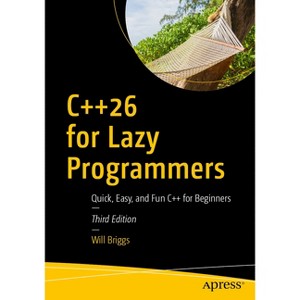
C++26 for Lazy Programmers - 3rd Edition by Will Briggs (Paperback)
Out of Stock
Sponsored
About this item
Highlights
- Ready to learn programming with less effort and more fun?
- About the Author: Will Briggs, PhD is a professor of computer science at the University of Lynchburg in Virginia.
- 662 Pages
- Computers + Internet, Programming Languages
Description
Book Synopsis
Ready to learn programming with less effort and more fun? Then do it the lazy way! C++26 for Lazy Programmers uses humor and fun to make you actually willing to read and eager to do the projects as you master the popular and powerful C++ language. Along the way it introduces features from the new C++26 standard including increased support for compile-time computation with constexpr and static_assert, as well as contracts, and covers ranges, views, move semantics, format strings, smart pointers, lambda functions and concepts (template parameter requirements), and provides brief introductions to coroutines and lazy evaluation. With this unique method, you'll stretch your abilities with a variety of projects, including your own C++ arcade game. You'll construct your own classes, templates, and abstract data types. After reading and using this book you'll be ready to build real-world C++ applications and game projects on your own. What You Will Learn:
- Explore the brand-new C++26 standard Program graphics and games with the SDL library, using SSDL, the "Simple SDL" wrapper library Use the most common C++ compilers - Visual Studio in Windows; g++ with Ubuntu, Fedora, Manjaro or Debian Unix, or MSys2 - and their associated debuggers Apply "anti-bugging" techniques for easy fixes to common problems Incorporate best practices for becoming a productive programmer Create your own big projects, including a C++-based arcade game Leverage STL functions and classes for easy and efficient programming Handle the Unicode (UTF-8) output Understand the uses and limits of views for efficiently pipelining data Learn core data types (strings, queues, vectors, linked lists) not by reading about them but by building them from scratch Navigate the basics of C, the still powerful and popular ancestor of C++
From the Back Cover
Ready to learn programming with less effort and more fun? Then do it the lazy way! C++26 for Lazy Programmers uses humor and fun to make you actually willing to read and eager to do the projects as you master the popular and powerful C++ language.
Along the way it introduces features from the new C++26 standard including increased support for compile-time computation with constexpr and static_assert, as well as contracts, and covers ranges, views, move semantics, format strings, smart pointers, lambda functions and concepts (template parameter requirements), and provides brief introductions to coroutines and lazy evaluation.
With this unique method, you'll stretch your abilities with a variety of projects, including your own C++ arcade game. You'll construct your own classes, templates, and abstract data types. After reading and using this book you'll be ready to build real-world C++ applications and game projects on your own.
What You:
-
- Explore the brand-new C++26 standard
- Program graphics and games with the SDL library, using SSDL, the "Simple SDL" wrapper library
- Use the most common C++ compilers - Visual Studio in Windows; g++ with Ubuntu, Fedora, Manjaro or Debian Unix, or MSys2 - and their associated debuggers
- Apply "anti-bugging" techniques for easy fixes to common problems
- Incorporate best practices for becoming a productive programmer
- Create your own big projects, including a C++-based arcade game Leverage STL functions and classes for easy and efficient programming
- Handle the Unicode (UTF-8) output
- Understand the uses and limits of views for efficiently pipelining data
- Learn core data types (strings, queues, vectors, linked lists) not by reading about them but by building them from scratch
- Navigate the basics of C, the still powerful and popular ancestor of C++
About the Author
Will Briggs, PhD is a professor of computer science at the University of Lynchburg in Virginia. He has 30 years experience teaching C++, 18 of them using earlier drafts of this book, and about as many years teaching other languages including C, Javascript, LISP, Pascal, PHP, PROLOG, and Python. His primary focus is teaching of late while also active in research in artificial intelligence.