Sponsored
In Stock
Sponsored
About this item
Highlights
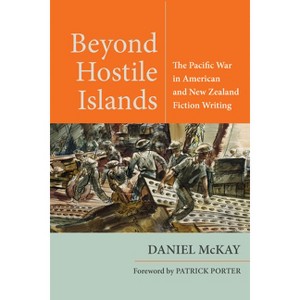
- WINNER, JAVIER COY BIENNIAL RESEARCH AWARD, BEST MONOGRAPH Offers a fascinating window into how the fraught politics of apology in the East Asian region have been figured in anglophone literary fiction.
- About the Author: Daniel McKay (Author) Daniel McKay is associate professor in the English Department, New Mexico Military Institute.
- 240 Pages
- Literary Criticism, Australian & Oceanian
- Series Name: World War II: The Global, Human, and Ethical Dimension
Description
Book Synopsis
WINNER, JAVIER COY BIENNIAL RESEARCH AWARD, BEST MONOGRAPH
Offers a fascinating window into how the fraught politics of apology in the East Asian region have been figured in anglophone literary fiction.
The Pacific War, 1941-1945, was fought across the world's largest ocean and left a lasting imprint on anglophone literary history. However, studies of that imprint or of individual authors have focused on American literature without drawing connections to parallel traditions elsewhere. Beyond Hostile Islands contributes to ongoing efforts by Australasian scholars to place their national cultures in conversation with those of the United States, particularly regarding studies of the ideologies that legitimize warfare. Consecutively, the book examines five of the most significant historical and thematic areas associated with the war: island combat, economic competition, internment, impris-onment, and the atomic bombing of Hiroshima and Nagasaki.
Throughout, the central issue pivots around the question of how or whether at all New Zealand fiction writing differs from that of the United States. Can a sense of islandness, the 'tyranny of distance, ' Māori cultural heritage, or the political legacies of the nuclear-free movement provide grounds for distinctive authorial insights? As an opening gambit, Beyond Hostile Islands puts forward the term 'ideological coproduction' to describe how a territorially and demographically more minor national culture may accede to the essentials of a given ideology while differing in aspects that reflect historical and provincial dimensions that are important to it. Appropriately, the literary texts under examination are set in various locales, including Japan, the Solomon Islands, New Zealand, New Mexico, Ontario, and the Marshall Islands. The book concludes in a deliberately open-ended pose, with the full expectation that literary writing on the Pacific War will grow in range and richness, aided by the growth of Pacific Studies as a research area.
From the Back Cover
"Beyond Hostile Islands is a beautifully-written, convincing, and accurate depiction of the Pacific War canon of Anglophone literature. It deploys American and New Zealand literary sources to trace the Allied racial hostility against Japan and its aftermath, as well as the dual imperialisms of Japan and the US."--Audrey Wu Clark, United States Naval Academy, author of Asian American Players, and Book Reviews Editor for the Society for US Intellectual History.
"McKay's approach to diverse Anglophone war literature authors, ranging from James Jones and Robert Barclay to Keri Hulme and Ruth Ozeki, allows readers to see the Pacific both locally and globally, genre by genre, helping to provide a necessary intertext of critique and vision amid the creative resources of hope and survivance."--Rob Sean Wilson, University of California, Santa Cruz, author of Reimagining the American Pacific: From South Pacific to Bamboo Ridge and Beyond.
"In this engagingly-written book, McKay has convincingly bridged the fields of literary studies and memory studies to offer a nuanced and thought-provoking account of the Pacific War in Anglophone literature. The New Zealand/Pacific Islands perspective adds a fresh comparative angle to the more familiar issues within US-Japan literary representations. The impressive range of (hi)stories discussed covers the well-known (Bridge on the River Kwai) to the all-but-forgotten (Japanese internment in New Zealand)."--Philip Seaton, Tokyo University of Foreign Studies, author of Japan's Contested War Memories: The 'Memory Rifts' in Historical Consciousness of World War II.
Offers a fascinating window into how the fraught politics of apology in the East Asian region have been figured in anglophone literary fiction.
The Pacific War, 1941-1945, was fought across the world's largest ocean and left a lasting imprint on Anglophone literary history. However, studies of that imprint or of individual authors have focused on American literature without drawing connections to parallel traditions elsewhere. Beyond Hostile Islands contributes to ongoing efforts by Australasian scholars to place their national cultures in conversation with those of the United States, particularly regarding studies of the ideologies that legitimize warfare. Consecutively, the book examines five of the most significant historical and thematic areas associated with the war: island combat, economic competition, internment, impris-onment, and the atomic bombing of Hiroshima and Nagasaki.
Throughout, the central issue pivots around the question of how or whether at all New Zealand fiction writing differs from that of the United States. Can a sense of islandness, the 'tyranny of distance, ' Māori cultural heritage, or the political legacies of the nuclear-free movement provide grounds for distinctive authorial insights? As an opening gambit, Beyond Hostile Islands puts forward the term 'ideological coproduction' to describe how a territorially and demographically more minor national culture may accede to the essentials of a given ideology while differing in aspects that reflect historical and provincial dimensions that are important to it. Appropriately, the literary texts under examination are set in various locales, including Japan, the Solomon Islands, New Zealand, New Mexico, Ontario, and the Marshall Islands. The book concludes in a deliberately open-ended pose, with the full expectation that literary writing on the Pacific War will grow in range and richness, aided by the growth of Pacific Studies as a research area.
Daniel McKay is an associate professor in the English Department at New Mexico Military Institute. His articles have appeared in MELUS, Mosaic, positions: east asia cultures critique, and University of Toronto Quarterly, among others.
Review Quotes
. . . McKay's Beyond Hostile Islands represents a useful survey and careful literary history other scholars and critics will be able to draw on and engage with for further research.-- "Journal of New Zealand Studies"
In this engagingly-written book, McKay has convincingly bridged the fields of literary studies and memory studies to offer a nuanced and thought-provoking account of the Pacific War in anglophone literature. The New Zealand/Pacific Islands perspective adds a fresh comparative angle to the more familiar issues within US-Japan literary representations. The impressive range of (hi)stories discussed covers the well-known (Bridge on the River Kwai) to the all-but-forgotten (Japanese internment in New Zealand).---Philip Seaton, Tokyo University of Foreign Studies, author of Japan's Contested War Memories: The 'Memory Rifts' in Historical Consciousness of World War II
Beyond Hostile Islands is an insightful and rewarding investigation of Pacific War literature, particularly that which confronted the economic rise of Japan in the 1980s and that which turned away from the atomic bombings of 1945. By comparing representations of the war across two different canons, the United States' and New Zealand's, McKay is able to bring a strong light to bear on this under-examined area of literary history.---Ian M. Richards, Osaka Metropolitan University, author of To Bed at Noon: The Life and Art of Maurice Duggan
A meditative and incisive reading of literature about WWII, Beyond Hostile Islands is book of brilliant comparisons: of US and Aotearoa-New Zealand literatures and of the bellicose topics of combat, internment, propaganda, and nuclear munitions. McKay's reading of what was known as "The Pacific War" takes a hard look at the ambivalences of war and its aftermath, providing a much-needed addition to Anglophone literary and cultural criticism and a new conversation about contemporary American and New Zealand island literatures.---Rebecca Weaver-Hightower, Virginia Tech University, author of Empire Islands: Castaways, Cannibals, and Fantasies of Conquest in Post/Colonial Island Narratives
Although it derives from "peacemaking" (pācificus) etymologically, the term "the Pacific" cannot fail to provoke the memory of war ironically. What McKay reveals in this book is not so much the political causes as the literary effects of the war, effects that foregrounded the power of nations by means of racialized stereotypes in narrative form.---Takayuki Tatsumi, Keio Academy of New York, author of Full Metal Apache: Transactions Between Cyberpunk Japan and Avant-Pop America
From combat novels to the corporate thriller, Beyond Hostile Islands examines the literary history of the Pacific War, while interrogating stereotypical renditions of the Japanese. The Pacific theatre is/was intrinsically archipelagic, and McKay - aware of an uneasy US-NZ juxtaposition - warns us that source material from island cultures/authors may unsettle, but also align with, continental world views. Beyond Hostile Islands is binary-bashing: it upsets culturalist, colonialist and imperialist narratives, exposing a messier humanity, and thus uncovers commonality amidst the dissimilar.---Godfrey Baldacchino, University of Malta, Founding editor, Island Studies Journal; Former President, International Small Island Studies Association (ISISA)
This book goes beyond more obvious avenues of enquiry to discuss how war stories may (or may not) be shaped by geographical 'islandness' or the political and cultural heritage of (interacting) Anglophone countries. The discussion of how representations of the Japanese shifted away from wartime combatants to quirky salarymen is especially illuminating.---Vandana Saxena, University of Malaya, author of Memory and Nation-Building: World War II in Malaysian Literature
About the Author
Daniel McKay (Author)
Daniel McKay is associate professor in the English Department, New Mexico Military Institute. His journal articles have appeared in MELUS, Mosaic, positions: east asia cultures critique, and University of Toronto Quarterly, among others.
Shipping details
Return details
Frequently bought together

Trending Paperback Books



Discover more options