Sponsored
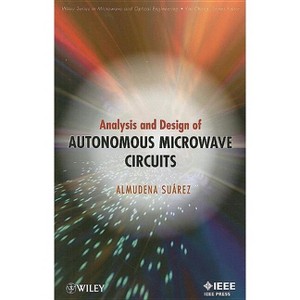
Autonomous Microwave Circuits - Wiley Microwave and Optical Engineering by Almudena Suarez Hardcover
In Stock
Sponsored
About this item
Highlights
- Presents simulation techniques that substantially increase designers' control over the oscillationin autonomous circuits This book facilitates a sound understanding of the free-running oscillation mechanism, the start-up from the noise level, and the establishment of the steady-state oscillation.
- About the Author: Almudena Suárez, PhD, is a Full Professor at the University of Cantabria, Spain, and a member of its Communications Engineering Department since 1993.
- 728 Pages
- Technology, Microwaves
- Series Name: Wiley Microwave and Optical Engineering
Description
Book Synopsis
Presents simulation techniques that substantially increase designers' control over the oscillationin autonomous circuits
This book facilitates a sound understanding of the free-running oscillation mechanism, the start-up from the noise level, and the establishment of the steady-state oscillation. It deals with the operation principles and main characteristics of free-running and injection-locked oscillators, coupled oscillators, and parametric frequency dividers.
Analysis and Design of Autonomous Microwave Circuits provides:
-
An exploration of the main nonlinear-analysis methods, with emphasis on harmonic balance and envelope transient methods
-
Techniques for the efficient simulation of the most common autonomous regimes
-
A presentation and comparison of the main stability-analysis methods in the frequency domain
-
A detailed examination of the instabilization mechanisms that delimit the operation bands of autonomous circuits
-
Coverage of techniques used to eliminate common types of undesired behavior, such as spurious oscillations, hysteresis, and chaos
-
A thorough presentation of the oscillator phase noise
-
A comparison of the main methodologies of phase-noise analysis
-
Techniques for autonomous circuit optimization, based on harmonic balance
-
A consideration of different design objectives: presetting the oscillation frequency and output power, increasing efficiency, modifying the transient duration, and imposing operation bands
Analysis and Design of Autonomous Microwave Circuits is a valuable resource for microwave designers, oscillator designers, and graduate students in RF microwave design.
From the Back Cover
Presents simulation techniques that substantially increase designers' control over the oscillationin autonomous circuits
This book facilitates a sound understanding of the free-running oscillation mechanism, the start-up from the noise level, and the establishment of the steady-state oscillation. It deals with the operation principles and main characteristics of free-running and injection-locked oscillators, coupled oscillators, and parametric frequency dividers.
Analysis and Design of Autonomous Microwave Circuits provides:
-
An exploration of the main nonlinear-analysis methods, with emphasis on harmonic balance and envelope transient methods
-
Techniques for the efficient simulation of the most common autonomous regimes
-
A presentation and comparison of the main stability-analysis methods in the frequency domain
-
A detailed examination of the instabilization mechanisms that delimit the operation bands of autonomous circuits
-
Coverage of techniques used to eliminate common types of undesired behavior, such as spurious oscillations, hysteresis, and chaos
-
A thorough presentation of the oscillator phase noise
-
A comparison of the main methodologies of phase-noise analysis
-
Techniques for autonomous circuit optimization, based on harmonic balance
-
A consideration of different design objectives: presetting the oscillation frequency and output power, increasing efficiency, modifying the transient duration, and imposing operation bands
Analysis and Design of Autonomous Microwave Circuits is a valuable resource for microwave designers, oscillator designers, and graduate students in RF microwave design.
About the Author
Almudena Suárez, PhD, is a Full Professor at the University of Cantabria, Spain, and a member of its Communications Engineering Department since 1993. She coauthored the book Stability Analysis of Nonlinear Microwave Circuits and contributed two articles to the Encyclopedia of RF and Microwave Engineering (Wiley). Professor Suárez has published dozens of papers in international journals and has been the leading researcher in several R&D projects. Her areas of interest include the nonlinear design of microwave circuits and, especially, stability and phase-noise analysis. She is a Distinguished Microwave Lecturer of IEEE.
Shipping details
Return details
Trending Computers & Technology Books