Sponsored
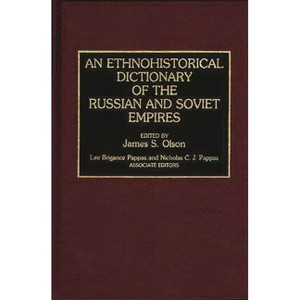
An Ethnohistorical Dictionary of the Russian and Soviet Empires - by James Stuart Olson Hardcover
In Stock
Sponsored
About this item
Highlights
- In 1991, the centrifugal forces of ethnic nationalism destroyed the Soviet Union.
- About the Author: JAMES S. OLSON is Professor of History at Sam Houston State University.
- 848 Pages
- Reference, General
Description
About the Book
In 1991, the centrifugal forces of ethnic nationalism destroyed the Soviet Union. Religious and ethnic issues will be the defining principles of political life in East Europe, Transcaucasia, and Central Asia for the next decade. Yet when most Americans and Europeans read, for instance, of the Ossetians and Ingush, they have no idea who these peoples are or why they are fighting. This volume will provide a ready reference for students, researchers, and librarians who are trying to sort out the political and social struggles in that part of the world. Focusing on ethnolinguistic groups rather than peoples with purely religious orientations, Olson provides entries on over 450 ethnic groups, with appropriate cross-references. Each entry concludes with references, and the volume includes a selected bibliography of English-language titles. The volume also includes a chronology, several appendixes providing statistical information, and an appendix essay on Islam in Russia and the Soviet Union.
Book Synopsis
In 1991, the centrifugal forces of ethnic nationalism destroyed the Soviet Union. Religious and ethnic issues will be the defining principles of political life in East Europe, Transcaucasia, and Central Asia for the next decade. Yet when most Americans and Europeans read, for instance, of the Ossetians and Ingush, they have no idea who these peoples are or why they are fighting. This volume will provide a ready reference for students, researchers, and librarians who are trying to sort out the political and social struggles in that part of the world. Focusing on ethnolinguistic groups rather than peoples with purely religious orientations, Olson provides entries on over 450 ethnic groups, with appropriate cross-references. Each entry concludes with references, and the volume includes a selected bibliography of English-language titles. The volume also includes a chronology, several appendixes providing statistical information, and an appendix essay on Islam in Russia and the Soviet Union.
Review Quotes
.,."a highly useful source for overviews of the various ethnic groupings and identifying English-language sources dealing with the issue. Recommended for academic libraries supporting Russian Studies programs."-Choice
?...a highly useful source for overviews of the various ethnic groupings and identifying English-language sources dealing with the issue. Recommended for academic libraries supporting Russian Studies programs.?-Choice
?A well written dictionary that all collections supporting research on Russia or the Soviet Union will want to purchase.?- Reference Book Review
?When one reads of the dislocations from their land, armed conflict and conquest, and the systemic oppression that some peoples have endured, it comes as no surprise that in the power vacuum caused by the collapse of the Soviet Union, ancient rivalries have surfaced and threaten to fracture further an already fractured empire. As those conflicts attract more and more attention in the West, this dictionary will become more important as a sound, accessible source of information about the groups, their grudges, and their aspirations.?-Wilson Library Bulletin
..."a highly useful source for overviews of the various ethnic groupings and identifying English-language sources dealing with the issue. Recommended for academic libraries supporting Russian Studies programs."-Choice
"A well written dictionary that all collections supporting research on Russia or the Soviet Union will want to purchase."- Reference Book Review
"When one reads of the dislocations from their land, armed conflict and conquest, and the systemic oppression that some peoples have endured, it comes as no surprise that in the power vacuum caused by the collapse of the Soviet Union, ancient rivalries have surfaced and threaten to fracture further an already fractured empire. As those conflicts attract more and more attention in the West, this dictionary will become more important as a sound, accessible source of information about the groups, their grudges, and their aspirations."-Wilson Library Bulletin
About the Author
JAMES S. OLSON is Professor of History at Sam Houston State University. He is the author of many books, including The Indians of Central and South America: An Ethnohistorical Dictionary (Greenwood, 1991) and Dictionary of United States Economic History (Greenwood, 1992).