Sponsored
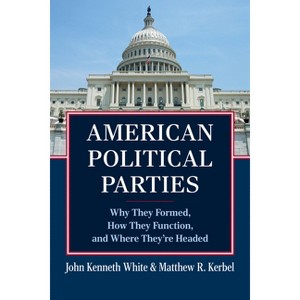
American Political Parties - by John Kenneth White & Matthew R Kerbel Paperback
In Stock
Sponsored
About this item
Highlights
- American Political Parties is a core textbook on political parties in the United States that places the US party system into a framework designed around the disagreements between Alexander Hamilton and Thomas Jefferson.
- Author(s): John Kenneth White & Matthew R Kerbel
- 240 Pages
- Political Science, Political Process
Description
About the Book
"American Political Parties is a core textbook on political parties in the United States. The book places the American party system into a framework designed around the disagreements between Alexander Hamilton and Thomas Jefferson. It argues that the two-party system in the United States began with a common agreement on the key values of freedom, individual rights, and equality of opportunity, but they disagreed-often vehemently-over how to implement these ideals into a form of governance. Hamilton wanted to marry freedom to a strong, active federal government with an energetic President who would act on behalf of all citizens. Jefferson believed that freedom should be married to local civic virtue with governmental responsibilities placed primarily at the local level. Today, Hamiltonian Nationalism finds its home in the Democratic Party, while Republicans have espoused Jeffersonian Localism since 1964. In addition to this historical framework, American Political Parties examines a range of topics, including marketing and social media, campaign finance, reforms in the presidential nominating process, political demography, and third parties. In this new edition (previously published as Party On!), the authors reflect on the future of the parties in the wake of the 2020 election"--
Book Synopsis
American Political Parties is a core textbook on political parties in the United States that places the US party system into a framework designed around the disagreements between Alexander Hamilton and Thomas Jefferson. White and Kerbel argue that the two-party system in the United States began with a common agreement on the key values of freedom, individual rights, and equality of opportunity but that Hamilton and Jefferson disagreed--often vehemently--over how to translate these ideals into an acceptable form of governance. This text develops a unique historical perspective of US party development using the disagreements between Alexander Hamilton and Thomas Jefferson as a framework for analysis.
While Hamilton wanted to marry freedom to a strong, active federal government with an energetic president who would act on behalf of all citizens, Jefferson believed that freedom should be allied to local civic virtue, with governmental responsibilities placed primarily at the local level. Today, Hamiltonian nationalism finds its home in the Democratic Party, while Republicans have espoused Jeffersonian localism since 1964. Using this historical framework, American Political Parties examines a range of topics including marketing and social media, campaign finance, reforms in the presidential nominating process, political demography, and third parties. In this new edition (previously published as Party On!), the authors describe four possible futures in the wake of the 2020 election and why Americans believed it was "the most important" election in their lifetimes.
The unique history of US political parties as set forth by the disagreements between Alexander Hamilton and Thomas Jefferson is at an inflection point. Republicans have become an insurgent party fully under the control of Donald Trump while Democrats have an opportunity to create a new majority coalition. This juncture poses unique challenges to our democracy and constitutional framework, and the book describes four possible outcomes, postulating where American political parties are headed in this decade.
Review Quotes
"By attending closely to the historical variety of party formations in American politics, White and Kerbel incisively answer the three crucial questions laid out in their book's subtitle. They root their analysis of parties' functions and behavior in the messy contingencies of actual political history, connecting parties' early republican origins to contemporary hyperpolarization in novel and effective ways."--Sam Rosenfeld, author of The Polarizers: Postwar Architects of Our Partisan Era
Shipping details
Return details
Frequently bought together



Guests also viewed

Discover more options