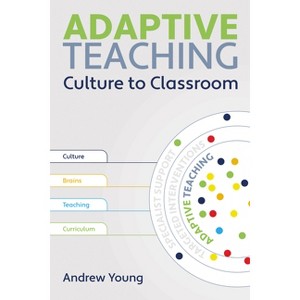
Adaptive Teaching - by Andrew Young (Paperback)
In Stock
About this item
Highlights
- Adaptive Teaching offers a grounded, compassionate guide to inclusive education.
- About the Author: Andrew Youngis a teacher of social sciences and Co-Director of the Pathfinder Teaching School Hub (TSH).
- 200 Pages
- Education, Special Education
Description
About the Book
Adaptive Teaching offers a grounded, compassionate guide to inclusive education. Based on a highly successful CPD programme, it is a thoughtful guide for teachers and school leaders who wish to learn more about SEND and gain sensible advice on how to teach inclusively by working smarter, not hard
Book Synopsis
Adaptive Teaching offers a grounded, compassionate guide to inclusive education. Based on a highly successful CPD program, it is a thoughtful guide for teachers and school leaders who wish to learn more about special educational needs and/or disabilities (SEND) and gain sensible advice on how to teach inclusively by working smarter, not harder.
By focusing less on labels and more on cognitive load, executive functioning and working memory and communication, the reader is equipped to cater for the needs of pupils with SEND in much more productive and sensitive ways. Rather than seeing the children as the barrier, this approach encourages teachers to understand the barriers that they are faced with, and this shift in perspective makes adaptive teaching feel achievable and transformative. Structured around four key areas (culture, brains, teaching and curriculum), this book connects theory to practice with clarity and purpose.
Adaptive teaching is not about adding more to a teacher's workload. It's about refining what we already know works, using pragmatic teaching and learning strategies and pupil-centered practice with greater care and intentionality. It means teaching to the margins and enabling pupils with additional needs to flourish, feeling a part of (rather than outside) our classroom culture.
Suitable for teachers and school leaders working in mainstream education, as well as special school or alternative provision staff.
Review Quotes
A must read for every classroom practitioner. An easy read which explores the issues that are relevant in every classroom today. Young encourages us to 'tackle the barrier not the child' whilst totally accepting the systemic problems that are in existence and acknowledges that issues won't be solved quickly.The encouragement to become 'detectives' beyond a label or diagnosis (which he argues are necessary but not sufficient) enables staff to identify underlying barriers of the big three cognitive areas, providing understanding to empower teachers to put provision in place sooner rather than later.I recommend all teachers, at whatever level of experience they are, to dive in - and if we can all achieve the culture of barrier removal in every classroom then we can be optimistic about the achievement of all children.
Gail Brown
Andrew Young's Adaptive Teaching: Culture to Classroom is the practical SEND handbook education has been waiting for. Writing from genuine classroom experience, Young cuts through overwhelming complexity with his 'big three' framework - working memory, executive function and cognitive load - giving teachers a unified lens for understanding diverse needs without requiring expertise in every condition.The book dismantles the damaging myth that 'adaptive teaching is just good teaching', validating teachers' experiences while providing the sophisticated knowledge they've been missing. Immediately applicable frameworks (the Four S's, Three-Pronged Approach, Graduated Response) offer concrete solutions that work within current constraints and where no unlimited budgets are required.What distinguishes this from theoretical texts is Young's realistic optimism. He acknowledges systemic failures while refusing to accept them as excuses for inaction, positioning inclusion as a collective responsibility rather than a specialist domain. Evidence-based without being academic, the guidance on curriculum design, cognitive science and teaching assistant deployment connects research to Monday-morning practice.Essential reading for teachers, SENDCos, senior leaders and local authorities facing the SEND crisis. This is hope grounded in evidence and genuinely workable solutions for inclusive excellence.
Gill Narinder
As more children and young people with SEND are educated in mainstream classrooms, ensuring consistent, high-quality provision for every learner is a critical priority for all teachers and leaders. Adaptive Teaching: Culture to Classroom offers a powerful, practical framework for delivering that vision.In the book, Andrew masterfully bridges the gap between ambitious pedagogical theory and practical, sustainable classroom implementation. The difference between this book and others on the market is that it is written by a practising teacher, who has specialised in this exact area, and throughout the book provides clear, practical classroom actions and advice that are instantly relatable and entirely relevant. By firmly rooting adaptive teaching in standard classroom practice, the author provides the practical means to deliver the Graduated Approach effectively at the universal level, giving every teacher the confidence and tools to meet the needs of all pupils. We can often hear the phrase, 'Every teacher is a teacher of SEND' - this book brings that essential statement to life.This book evidences inclusion as a core design principle. It will help reframe the narrative for any school teacher or leader committed to equitable, high-impact practice for all pupils.
Katherine Walsh
I absolutely loved this book. What sets it apart is how down to earth it is - no jargon, no over-complication, just clear, practical advice rooted in real classrooms. The use of examples, and particularly non-examples, is brilliant. Too often, teachers think they are applying a strategy effectively but have actually picked up the wrong end of the stick; this book makes it crystal clear what good adaptive teaching looks like and how to avoid common pitfalls.Andy writes with both authority and authenticity, drawing not only on theory but on genuine experience from working in schools. That balance makes the book incredibly readable as well as useful - it feels like guidance from someone who has been there, understands the challenges and knows what works.
Kay Shepherd
In a context of increasingly diverse classrooms, this book is both a timely resource and a necessary provocation for educators.This book provides approaches that are underpinned by current theory and reflect a deeper understanding of special educational needs, picking at the complexities inherent in supporting all pupils, whilst also supporting teachers with concrete pathways forward.The writing style is both accessible and engaging, with the author speaking directly to the reader in a way that feels personal and conversational. This candid, open tone makes the book particularly effective as a tool for reflection and change, with the author inviting readers to question their own assumptions and consider different approaches to maximise pupil engagement and achievement.At the heart of the book is the interconnected goals of enabling pupils with additional needs to achieve their full potential, whilst simultaneously fostering a genuine sense of belonging in the classroom.This is an important contribution to the field that will undoubtedly support teachers and teacher educators in their vital work of helping all pupils learn, develop, and flourish.
Keither Parker
No education system could be said to be flourishing if children with the greatest needs were not prioritised. This inspirational and highly practical book brings this vision to life through the author's lived experience as an expert thinker, practitioner and developer of people. It will empower adults working across a range of roles in schools to ensure that each end every child is appropriately supported, loved, empowered and championed, and that each adult supporting that child has the time, resources, expertise and collaborative networks to ensure the tailored support meets each individual need.The book places the most vulnerable at the heart of a transformational vision for education - but moves adeptly beyond rhetoric, facing into the inevitable challenges this presents, but offering a hope-filled vision of an education system in which all children flourish.
Andy Wolfe
This is a terrific book. The author enables a step change in our discussions about adaptive teaching; it's so important to consider inclusive practice in context and connect teacher behaviours to the inclusive culture of every classroom. Great diagrams and succinct explanations will help teachers to apply the strategies and the principles so sharply articulated here. This is a book that busy teachers can access easily and use to build on current expertise, rapidly enhancing their inclusive practice to meet diverse needs.
Margaret Mulholland
This is a timely and perfectly pitched book for all those dealing with the challenges and rewards of making their practice as inclusive as possible for every pupil. Its practical but principled approach will be particularly useful for trainees and ECTs, but there are also helpful discussion points and actionable advice for every level. I particularly welcome the recognition that an over-reliance on cognitive science can lead to a narrow approach that can be exclusive to some and risks overlooking the complex factors involved in learning and thriving. I thoroughly recommend this book to both practitioners and those who support them.
Samantha Twiselton
This manuscript is a timely and important contribution to the ongoing conversation about how schools can better support children and young people with SEND. It combines robust research with a deep awareness of the practical challenges faced daily by teachers, leaders and support staff. It is easy to write about adaptive teaching in an abstract way, but one of the book's greatest strengths is how it connects theory to the lived realities of classrooms. At a time when many schools are grappling with limited resources, increasing complexity of need and growing pressures on inclusion, the insights offered here feel both authentic and achievable. Crucially, the work does not shy away from addressing systemic issues, such as staff capacity and the barriers families often encounter. Instead, it offers practical strategies and hopeful perspectives that can help schools foster resilience and inclusion, even in challenging circumstances. I would strongly recommend it.
Haili Hughes
About the Author
Andrew Youngis a teacher of social sciences and Co-Director of the Pathfinder Teaching School Hub (TSH). He leads the design, delivery, and oversight of professional development programs across North Yorkshire, Northern England. He also manages the TSH Initial Teacher Training (ITT) programs in partnership with York St John University, training around 50 new teachers each year. Andrew secured Department for Education (DfE) approval for the Teaching School Hub's Adaptive Teaching CPD program and has since worked with hundreds of staff and schools to foster inclusive classroom environments.
Shipping details
Return details
Additional product information and recommendations
Discover more options




Trending Education Books